
May 4, 2026

Uncategorized

The Illusion of Choice: Why Your “Vector Database Decision” Is Probably Already Made

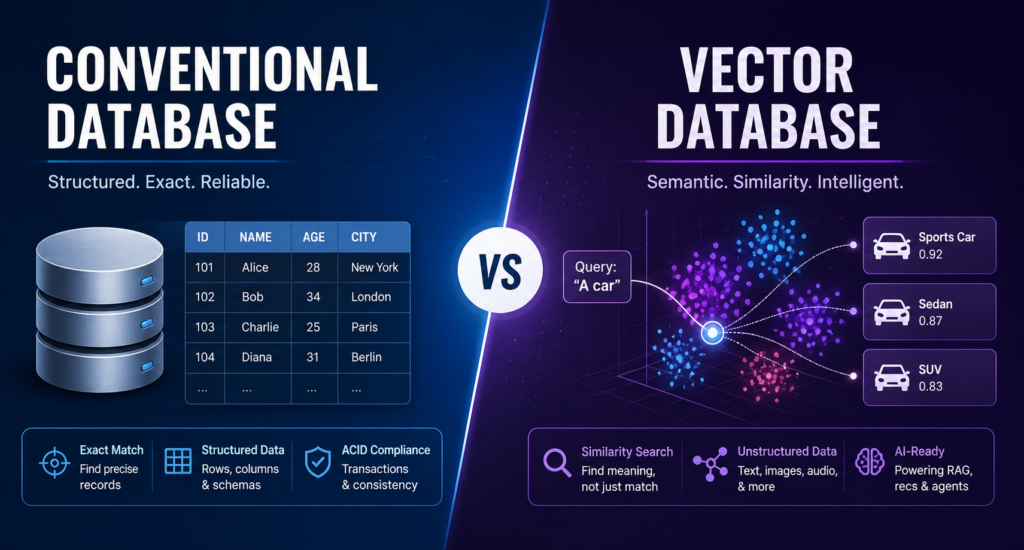
There is a growing ritual in enterprise AI teams. A new initiative begins—usually framed as “RAG,” “semantic search,” or “agentic workflows”—and within weeks the conversation collapses into a familiar question: Which vector database should we choose? Pinecone or Qdrant. Milvus or Weaviate. Managed or self-hosted. Benchmarks are pulled. Latency numbers are compared. Architecture diagrams get redrawn. It feels like a meaningful decision. It is not. In most cases, the decision has already been made—quietly, structurally, and upstream—long before the team starts comparing vendors. What looks like a tooling choice is actually a consequence of something deeper: where your data lives, how your systems are governed, and what failure you can tolerate. The mistake is not choosing the wrong vector database. The mistake is believing that this is the layer where the real decision sits. The Category Error That Keeps Repeating The modern data stack is undergoing a shift from symbolic retrieval to semantic retrieval. That much is clear. What is less clear—and routinely misunderstood—is how this shift integrates with existing systems. The common narrative suggests a clean replacement: Traditional databases store structured data Vector databases store embeddings Therefore, vector databases are the future This framing is wrong. Vector systems are not replacements. They are retrieval mechanisms. They operate in a different space—geometric rather than symbolic—and they solve a different problem: finding meaning, not matching conditions. A relational database answers: “Find all records where X = Y.” A vector system answers: “Find the closest representations to this idea.” These are not competing abstractions. They are orthogonal. Yet the market continues to present them as alternatives, and teams continue to evaluate them as if they are substitutable. That is the first failure. What Actually Differentiates Systems When you strip away branding and positioning, every system in this space resolves into a small set of architectural choices: Where is the data stored? How is similarity computed? What is the latency envelope? How are updates handled? What operational burden does the system introduce? Everything else—APIs, SDKs, integrations—is surface area. The real differences emerge in how systems answer these questions. A relational database with vector support will store embeddings alongside structured data, but its indexing and update model is constrained by transactional workloads. A purpose-built vector system will optimize for approximate nearest neighbor search, often at the cost of operational simplicity. A lakehouse system will treat embeddings as another column in a massive analytical store, optimizing for scale and governance rather than latency. These are not incremental differences. They define the behavior of the system under stress. The Three Equilibria That Are Actually Emerging If you observe production deployments rather than vendor narratives, a pattern appears. The ecosystem is not converging to a single dominant architecture. It is stabilizing around three distinct equilibria. 1. The Integrated OLTP Stack This is the default path. A team already runs PostgreSQL, MongoDB, or Cassandra. Vector capability is added—via extensions, plugins, or native features. The system now supports embedding storage and similarity queries alongside existing workloads. The appeal is obvious: No new infrastructure Familiar operational model Strong consistency guarantees For many use cases, this is sufficient. Especially when the dataset is modest and the latency requirements are not extreme. But the failure mode is predictable. As the number of vectors grows and update frequency increases, the indexing structures—often graph-based (such as HNSW)—begin to degrade. Maintaining recall requires periodic re-indexing. Re-indexing consumes resources. Those resources compete with transactional workloads. The system enters a tension: Serve queries fast Maintain index quality Preserve transactional performance It cannot optimize all three simultaneously. This is where most teams discover that their “simple” solution has a ceiling. 2. The Specialized Retrieval Stack This is the performance path. Purpose-built systems—such as those designed around approximate nearest neighbor algorithms—optimize aggressively for retrieval: High recall under tight latency constraints Advanced filtering and hybrid search Scalable indexing across large datasets These systems treat vector search as a first-class problem, not an add-on. The benefits are real: Predictable performance at scale Flexible retrieval strategies Better control over indexing behavior But they introduce a different class of problems. The most obvious is data duplication. Your source data lives in one system. Your embeddings—and often copies of metadata—live in another. Keeping them synchronized becomes a continuous process. Failures in this pipeline introduce inconsistencies that are difficult to detect. The second problem is operational: New infrastructure New scaling concerns New failure modes The system is more powerful, but also more complex. 3. The Lakehouse / Analytical Stack This is the governance path. In many enterprises, data already resides in analytical platforms—data warehouses or lakehouses. These systems have begun to incorporate vector capabilities directly. The logic is not performance. It is control. Data stays where it already lives Access controls remain consistent Lineage and auditability are preserved This eliminates one of the most painful aspects of the specialized stack: duplication and synchronization. It also leverages data gravity—moving computation to data, rather than data to computation. But the trade-off is clear. These systems are not designed for low-latency retrieval. They excel at batch processing, large-scale analysis, and governed access—not real-time interaction. For use cases like offline retrieval, analytics-driven RAG, or large-scale document processing, this model is effective. For interactive systems—especially those requiring sub-100ms responses—it is not. Why Most “Vector DB Evaluations” Miss the Point The industry’s current obsession with comparing vector databases assumes that the decision sits at that layer. It does not. The choice is constrained by three upstream factors: 1. Data Location If your data already resides in a lakehouse, the cost of extracting, transforming, and duplicating it into a separate system is not trivial. If your application is tightly coupled to a relational database, introducing a second system changes the architecture more than the retrieval mechanism itself. The question is not: “Which vector database is best?” It is: “Where can I afford to move or duplicate data?” 2. Latency Requirements Different use cases impose different constraints. Offline analysis tolerates seconds or minutes Interactive applications demand milliseconds Agentic systems often require tight
Uncategorized

Why It Is Believed AI Will Create More Jobs Than It Destroys?

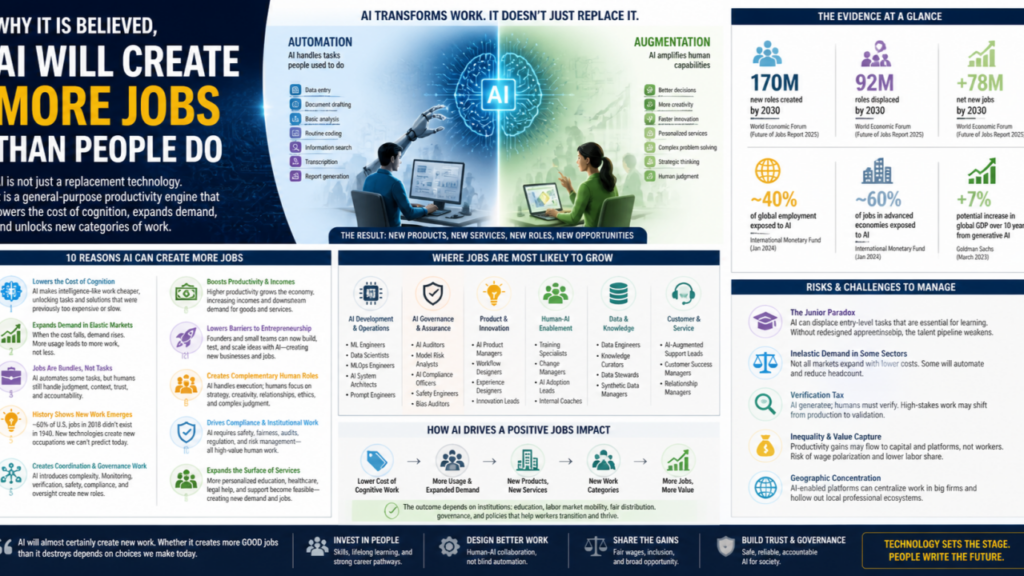
The belief that AI will create more jobs than it destroys does not come from optimism alone. At its strongest, it comes from a particular economic reading of technological change: AI is not merely a tool that substitutes for human labour; it is a general-purpose technology that lowers the cost of cognition, expands the frontier of feasible work, creates new demand, and generates new coordination, verification, governance, and maintenance functions around itself. But the claim is often overstated. AI may create more work than it destroys. Whether that work becomes stable, well-paid, geographically distributed, and socially useful jobs is a separate question. That distinction is essential. The serious version of the claim is this: AI will create jobs if cheaper cognitive execution expands demand faster than it displaces existing task labour, and if institutions convert that new demand into durable occupations. That is the analytical core. 1. The first reason: AI lowers the cost of cognition Every major productivity technology reduces the cost of some scarce input. The steam engine reduced the cost of mechanical power. Electricity reduced the cost of distributed energy. Computers reduced the cost of calculation and information processing. The internet reduced the cost of communication and distribution. AI reduces the cost of cognition-like tasks: drafting, summarising, classifying, coding, translating, searching, designing, recommending, comparing, detecting, planning, and simulating. This matters because many activities were not previously impossible; they were simply too expensive, too slow, or too skill-dependent. A small business may have wanted analytics but could not afford an analyst. A teacher may have wanted personalised learning material but did not have the time. A lawyer may have wanted deeper precedent scanning but could not justify the hours. A journalist may have wanted to examine thousands of documents but lacked manpower. A product team may have wanted to test twenty prototype ideas but had capacity for three. AI changes the economics of these “latent tasks.” When the cost of a useful input falls, three things can happen. First, firms produce the same output with fewer workers. That is the displacement story. Second, firms produce more output with the same workers. That is the productivity story. Third, entirely new products, services, workflows, and business models appear because the input has become cheap enough to use everywhere. That is the job-creation story. The job-creation argument depends mainly on the third effect. This is why AI is compared to previous general-purpose technologies. The most important economic effect of a general-purpose technology is not the first automation use case. It is the second-order reorganisation of industries around the newly cheap input. Electricity did not merely replace steam engines. It redesigned factories. Computers did not merely replace clerks. They enabled software, digital finance, logistics optimisation, e-commerce, cloud computing, and platform businesses. AI may not merely replace writers, analysts, or coders. It may redesign how decisions, services, interfaces, products, audits, education, care, and enterprise workflows are produced. That is why the claim is plausible. But plausibility is not certainty. 2. The second reason: demand can expand when cost collapses The most common economic logic behind the claim is the rebound effect, often discussed through Jevons Paradox. If a technology makes a resource more efficient, total consumption of that resource may rise because it becomes cheaper and more widely usable. Applied to AI, the argument is simple: If the cost of intelligence-like work falls, society may consume far more intelligence-like work. That means more analysis, more software, more documentation, more monitoring, more customer interaction, more tutoring, more design, more experimentation, more compliance checks, more simulations, more internal tools, and more personalised services. The classic modern example is ATMs and bank tellers. ATMs reduced the number of tellers required per branch, but they also lowered the cost of operating branches. Banks opened more branches, and teller work shifted toward relationship management and sales rather than only cash handling. James Bessen’s account notes that the average number of tellers needed per urban branch fell from 20 to 13 between 1988 and 2004, while urban bank branches increased by 43%, so teller jobs did not disappear in the simple way many expected. (IMF) The lesson is not that automation always saves jobs. The lesson is more precise: If automation reduces unit cost and demand is elastic, total employment can rise even when labour per unit falls. This is the heart of the AI job-creation argument. For AI, the elastic-demand sectors are likely to include software development, content production, education support, marketing, cybersecurity, analytics, internal automation, compliance monitoring, translation, simulation, product experimentation, and small-business services. Many organisations currently under-consume these services because they are expensive. If AI reduces cost, demand may expand. For example, a company that previously built two dashboards may now build twenty decision-support systems. A teacher who previously prepared one standard worksheet may create ten personalised learning paths. A compliance team that sampled 2% of transactions may monitor 100% of cases with AI-assisted triage. A startup that previously needed five engineers for a prototype may launch with two engineers and one AI-augmented operator. In each case, AI does not merely remove labour. It changes the scale of feasible activity. However, the elasticity condition is critical. If demand does not expand, AI becomes a labour-saving tool rather than a job-creating tool. A company does not need ten statutory audits because audits become cheaper. A bank does not necessarily need ten times more regulatory filings. A law department may not need ten times more contracts. A hospital may not need ten times more discharge summaries if clinical throughput is constrained elsewhere. So the correct model is not: AI lowers cost → demand rises → jobs increase. The correct model is: AI lowers cost → demand rises where demand is elastic → new roles emerge where institutions convert that demand into occupations. That conditional structure is often missing in casual claims. 3. The third reason: jobs are task bundles, not single tasks Most public debate fails because it treats jobs as if they are single activities. But

Selection process
Uncategorized

What is unique about the QLI’S Admission Process?

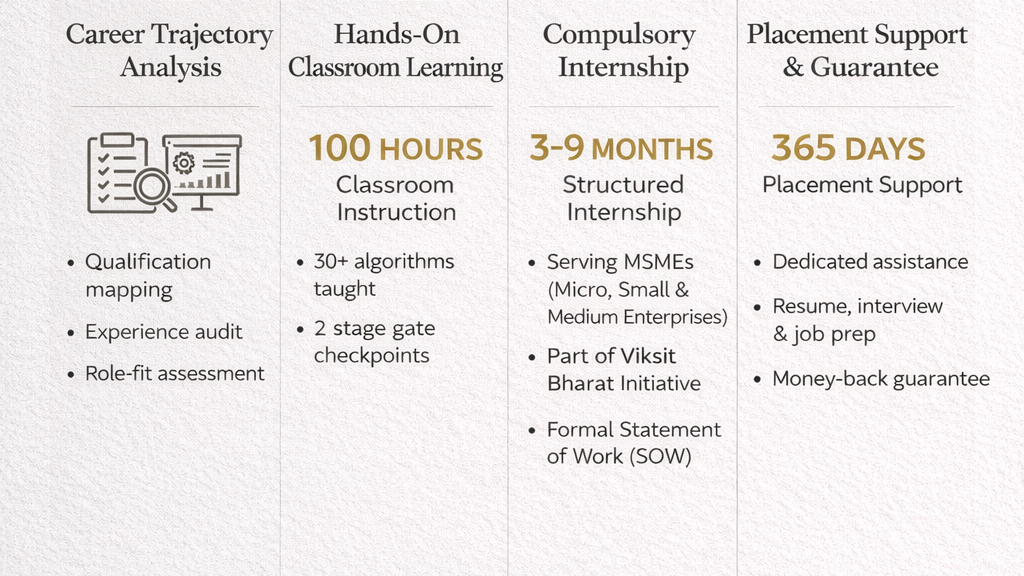
What is QLI, what it runs, and why its model is unique and structurally different 1. What is QLI? QLI (QAF Lab India) is not a conventional training institute. It is a capability-and-placement lab operated by QAF Lab India, designed to close a specific market failure: Degrees certify exposure. Bootcamps teach tools. Employers demand proof of delivery. QLI exists to bridge this gap by converting learners into verifiable, work-tested professionals through a controlled pipeline: diagnosis → instruction → execution → placement. It positions itself closer to a talent transformation system than an education vendor. 2. Flagship Programs (QLI Core) QLI’s curriculum architecture is anchored around two flagship certifications, each mapped to enterprise-grade roles. ● Certified Enterprise Transformation Analyst (CETA) Focus: Enterprise transformation, AI strategy, operating models, and systems thinking. Outcome: Analysts who can reason across governance, IT, operations, finance, and risk—not just code or tools. Typical role trajectories: Enterprise / Business Transformation Analyst AI Strategy & Operating Model Analyst Digital Transformation Consultant ● Certified Algorithmic Bias Auditor (CABA) Focus: Algorithmic risk, bias, governance, auditability, and regulatory alignment. Outcome: Professionals who can audit and govern AI systems under real-world constraints. Typical role trajectories: Algorithmic Bias Auditor Responsible AI / Model Risk Analyst AI Governance & Compliance Specialist Key point: These programs are role-first, not syllabus-first. Content is derived backward from what industry can actually employ. 3. How QLI Places Candidates (Mechanism, not marketing) QLI does not promise placement by résumé circulation alone. Placement is treated as a systems problem, solved through four enforced stages: Stage 1 — Career Trajectory Analysis Qualification mapping Experience audit Role–fit assessment Purpose: Eliminate mismatch early. This reduces downstream placement failure. Stage 2 — Hands-On Classroom Learning ~100 hours of structured instruction 30+ algorithms / frameworks Stage-gated evaluations Purpose: Ensure baseline competence before real exposure. Stage 3 — Compulsory Internship (3–9 months) Real projects with MSMEs Formal Statement of Work (SOW) Delivery artifacts, not simulated case studies Purpose: Convert learning into verifiable proof-of-work. Stage 4 — 365-Day Placement Support Dedicated placement assistance Resume, interview, and job-readiness prep Money-back guarantee (as per T&Cs) Purpose: Placement treated as a process window, not a one-day event. Structural insight: Employers hire QLI candidates because they come with auditable work outputs, not just certificates. 4. QLI Membership — What You Actually Get QLI membership is the operating layer that makes the above system work. Core Benefits Access to flagship programs (CETA / CABA) 100+ hours of structured classroom learning Mandatory industry internship pipeline 365 days of placement support Flexible schedules (working professionals & students) EMI / financing options Money-back guarantee (conditions apply) Strategic Benefit (often missed) Membership is not transactional. It embeds the learner into: An enterprise-aligned curriculum ecosystem A mentor + evaluator network A delivery-first credibility model This is why QLI positions itself as a lab, not an academy. 5. Bottom Line (Unvarnished) QLI does not sell education alone It sells employability under constraints Its advantage lies in enforced internships, SOW-based work, and long-horizon placement support In a market flooded with certificates, QLI optimizes for the only signal that survives scrutiny: demonstrated, documented delivery.

Scroll to Top