

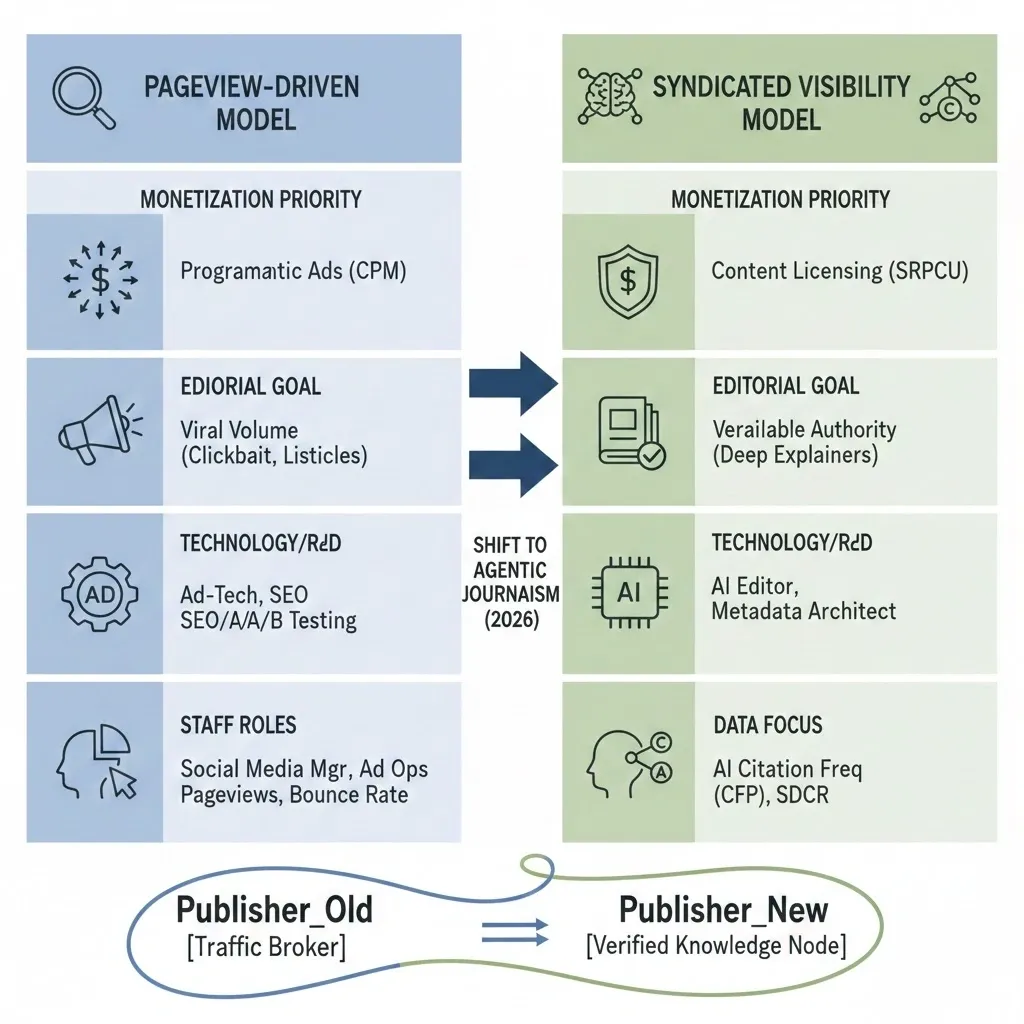
The Era of Syndicated Visibility: Agentic (AI) Journalism.
Why being quoted by machines, not clicked by humans, will decide the future of news Introduction: When the Click Stopped Being the Unit of Truth For nearly three decades, the economics of digital journalism rested on a deceptively simple assumption: if you could attract attention, you could monetise it. Pageviews became the proxy for relevance, clicks the proxy for value, and referral traffic the proxy for power. News organisations learned to live and die by dashboards that counted sessions, bounce rates, and organic search volume. The homepage was king. The article URL was the atomic unit of distribution. That world is now ending—not with a dramatic collapse, but with a quiet erosion. The defining shift of late 2025 is not that artificial intelligence can now summarise the news. That was inevitable. Nor is it that search engines are changing how results are presented. They always do. The real rupture is subtler and more consequential: Journalism is being consumed increasingly without being visited. Readers are no longer required to enter a publisher’s site to encounter its reporting. They meet journalism inside AI-generated answers—compressed, reassembled, contextualised, and presented as part of a larger synthetic response. The article still exists, but the user session does not. In this new environment, the primary question for a newsroom is no longer “How many people came to us?” but rather: “How often, how prominently, and how accurately were we quoted by the machines that now mediate knowledge?” This is what we mean by syndicated visibility—sometimes called quoted-by-AI visibility. It is the emerging metric of success in an ecosystem where visibility flows through intermediaries that do not hand over traffic in proportion to value extracted. The implications are profound. Journalism is returning, in a transformed guise, to a model that predates the web: syndication. But unlike wire services of the 20th century, this syndication is algorithmic, opaque, and global by default. And unlike the old world, where syndication was a supplement to direct readership, here it is fast becoming the main channel. This essay argues that syndicated visibility is not a buzzword or a temporary adaptation. It is the structural logic of news distribution in the AI era. Understanding it—measuring it, optimising for it, and governing it—will determine whether journalism remains a viable public institution or dissolves into an uncredited input layer for machine intelligence. I. The End of the Click-Centric World 1. The slow death of referral traffic Search once delivered readers to publishers in abundance. That bargain—content in exchange for visibility—was never entirely fair, but it was stable enough to build an industry around. SEO became a craft, then a science, then a pathology. Entire editorial strategies were shaped by keyword demand curves and Google’s shifting incentives. AI summaries have broken this equilibrium. By late 2025, multiple independent datasets—industry reports, academic studies, and browser-level behavioural analyses—converged on the same conclusion: when an AI-generated answer appears, users are significantly less likely to click through to source websites. In some categories, the decline is modest; in others, catastrophic. But the direction is unambiguous. More importantly, zero-click consumption has become normal behaviour. Users are no longer dissatisfied when they do not visit a publisher. They believe they have already “read the news” because an answer has been rendered complete at the interface level. This is not a failure of journalism. It is a triumph of interface design. 2. Why “better headlines” will not save you Many newsrooms initially responded with familiar instincts: optimise headlines, tighten summaries, improve metadata, hope to win back clicks. This misunderstands the nature of the shift. AI answers are not competing with articles in the way one headline competes with another. They are replacing the act of browsing itself. The user is no longer choosing between links; the system is choosing on their behalf what to incorporate, compress, and present. In that environment, marginal improvements in click-through rates are irrelevant. The competition has moved upstream—from user attention to machine selection. II. Defining Syndicated Visibility 1. What it is—and what it is not Syndicated visibility refers to a publisher’s success inside AI-mediated responses, not outside them. It captures three core dimensions: This is not traditional syndication. There is no explicit contract for each instance of reuse. There is no negotiated placement or guaranteed audience. And there is often no click. But functionally, it serves the same role: your journalism circulates beyond your owned surfaces, embedded in other products, generating value you do not fully control. 2. Why “quoted-by-AI” matters more than “ranked on Google” In the classic search era, ranking first meant visibility. In the AI era, being quotable matters more than being rankable. AI systems prefer sources that are: This subtly but decisively favours certain kinds of journalism: explanatory reporting, primary-source analysis, investigative work with clear evidentiary chains. It disfavors content optimised purely for novelty or outrage without grounding. This is not necessarily a moral victory—but it is a structural one. III. Why Syndicated Visibility Emerged in 2025 (Not Earlier) 1. The maturation of AI interfaces Earlier AI systems could generate text, but they were unreliable narrators. Publishers could plausibly dismiss them as toys, plagiarism engines, or hallucination factories. That dismissal is no longer credible. By late 2025, AI-generated answers have become: The shift crossed a threshold from experimentation to infrastructure. 2. The collapse of the “drive traffic, then monetise” loop The old model assumed a linear flow: Search → Article → Engagement → Revenue AI breaks this loop: Search → Answer → Satisfaction → Exit The article may be present, but the loop no longer passes through the publisher’s site. Once that loop breaks at scale, traffic ceases to be a reliable proxy for impact. Syndicated visibility fills that void. It is not a perfect replacement—but it is the only metric that corresponds to where journalism is actually being consumed. IV. The New KPI Stack in Newsrooms 1. From clicks to citations Forward-looking publishers are already shifting internal dashboards away from raw traffic metrics and toward indicators such as: This is not an abandonment of audience measurement. It is an acknowledgment that the location of audience contact has