Career in Enterprise AI

Describes about the career in AI.

Artificial Intelligence, Career in Enterprise AI, Enterprise Transformation

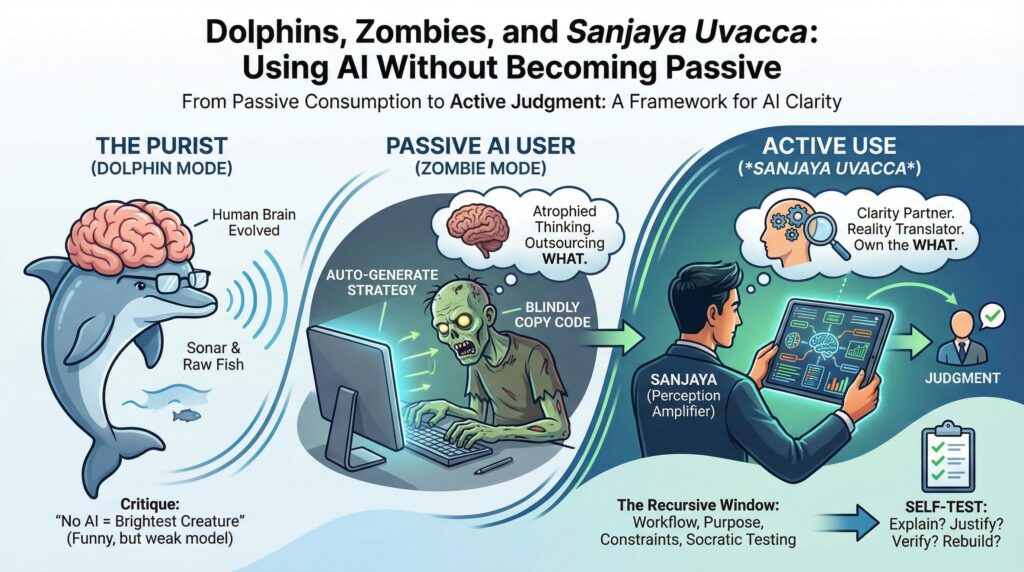
Dolphins, Zombies, and Sanjaya Uvacca: Using AI Without Becoming Passive

When people are substituting mankind with machinekind, there are certain collateral damage happens. It is quite normal, luddites of AI era, have been on the rise. Here what is being claimed, the changes in the structure of brain. New anatomical evidence reveals the shocking difference between AI users and AI purists. According to a rigorous scientific diagram, if you strictly refuse to use LLMs, your brain doesn’t merely remain human. It evolves into a massive, highly complex organ capable of sonar and eating raw fish. You basically become a bottlenose dolphin. 🐬 Some critics kind of imply: “Those who don’t use AI are dolphins: the brightest and smartest creatures swimming among us ChatGPT zombies.” Funny line. Weak model. Because the real dividing line isn’t AI vs no AI. It’s passive use vs active use. Let me show you the anatomy of the Nueral Machine ( Machine Brain). And Credits: Graphcore. Apply for 500+ Semiconductor jobs in Graphcore, Bangalore. Graphcore, now a wholly owned subsidiary of SoftBank Group, will invest up to £1 billion over a decade to establish an AI Engineering Campus in Bengaluru. The plan targets ~500 semiconductor jobs, with ~100 roles hired immediately across silicon logic/physical design, verification, characterization, and bring-up. The expansion in India is paired with a UK headcount increase to ~750, primarily in silicon, software, and AI engineering. The campus will contribute to Graphcore’s end-to-end AI compute stack (silicon, systems, software). SoftBank’s broader AI push includes large-scale infrastructure initiatives such as Stargate, in partnership with OpenAI and Oracle. SoftBank reports >$12 billion invested in India over the past decade. Rationale (explicitly stated): Bengaluru’s concentration of universities, startups, and multinational tech talent. Alignment with Indian government semiconductor initiatives and skills development. Implications (inference, bounded): Signals deepening global semiconductor R&D presence in India, not just services. Positions Graphcore to scale AI silicon development capacity while diversifying talent geography. Reinforces SoftBank’s strategy to vertically integrate AI infrastructure—from chips to platforms. Bottom line: This is a long-horizon R&D and talent bet, anchoring advanced semiconductor engineering in India while integrating Graphcore into SoftBank’s broader AI infrastructure agenda. Career at Graphcore Director / Senior Principal AI SoC Validation (Bring-up lead)Engineering – SiliconApply now Principal Bring-Up and Characterisation EngineerEngineering – SiliconApply now Principal Embedded SW/FW Engineer (Bringup) – Bengaluru, multiple vacanciesEngineering – SiliconApply now Principal Silicon Physical Design Engineer – BengaluruEngineering – SiliconApply now Principal Silicon Verification Engineer – BengaluruEngineering – SiliconApply now Senior Bring-Up and Characterisation Engineer – BengaluruEngineering – SiliconApply now Senior Bring-Up and Characterisation Engineer – Bengaluru, Multiple VacanciesEngineering – SiliconApply now Senior Bring-Up and Characterisation Engineer – Bengaluru, Multiple VacanciesEngineering – SiliconApply now Senior Embedded SW/FW Engineer (Bringup) – Bengaluru, multiple vacanciesEngineering – SiliconApply now Senior Embedded SW/FW Engineer (Bringup), Bengaluru, multiple vacanciesEngineering – SiliconApply now Senior Silicon Physical Design Engineer – BengaluruEngineering – SiliconApply now Senior Silicon Verification EngineerEngineering – SiliconApply now Silicon Physical Design Engineer – Bengaluru, Multiple VacanciesEngineering – SiliconApply now Staff Bring-Up and Characterisation EngineerEngineering – SiliconApply now Staff Bring-Up and Characterisation Engineer – BengaluruEngineering – SiliconApply now Staff Embedded SW/FW Engineer (Bringup) – BengaluruEngineering – SiliconApply now Staff Silicon Logical Design Engineer – Bengaluru, Multiple VacanciesEngineering – SiliconApply now Staff Silicon Physical Design Engineer – BengaluruEngineering – SiliconApply now Staff Silicon Verification Engineer – Bengaluru, Multiple VacanciesEngineering – SiliconApply now The Connotation We’re Beating: “Using AI Makes You Passive” There’s truth inside the fear. If you stop exercising a muscle, it atrophies. If you use AI to replace thinking, you’ll get worse at thinking. That’s what “getting dumber” looks like in practice: blindly copy-pasting code you can’t explain, auto-generating strategy you can’t defend, letting autocomplete decide your business logic, accepting output without checking assumptions. But here’s the distinction people keep skipping: Outsourcing thought and outsourcing execution are two different things. AI can accelerate the HOW—drafting, refactoring, summarizing, exploring options. Humans must own the WHAT—what matters, what to build, what tradeoffs to accept, what “good” looks like, what you’re willing to be accountable for. Passive consumption makes you dumber. Active use makes you sharper. So how do you force active use every time? That’s where Sanjaya Uvacca comes in. Sanjaya Uvacca: Not “Just a Narrator,” But a Discipline of Clarity “Sanjaya uvāca” literally reads as “Sanjaya said…”—and it’s easy to treat that like a speaker label you skip past. But Sanjaya isn’t a decorative narrator. He’s an archetype: the lucid witness who can stand near chaos without being swallowed by it, and transmit what matters without distortion. And that gives us the cleanest metaphor for using AI well: In the Mahabharata, Sanjaya is the bridge between battle and blindness: he translates an overwhelming battlefield into clear perception for someone who cannot see it directly—without taking the choice away from him. That’s the most accurate metaphor for Artificial Intelligence. Our “battle” is complexity (information overload, shifting contexts, endless variables). Our “blindness” is cognitive (limited attention, limited time, partial knowledge). Used well, AI becomes a Sanjaya: it expands perception—summarizes, compares, surfaces risks, reveals tradeoffs—so the human can answer the harder question of what matters and what to do. Used poorly, AI stops being a bridge and becomes a crutch: it doesn’t cure blindness, it replaces judgment. So the goal is not “use AI” or “don’t use AI.” The goal is: use AI like Sanjaya. Perception amplifier. Clarity partner. Reality translator. Not a substitute decision-maker. The Recursive Window: Features That Make Passive Use Hard I don’t rely on a “magic prompt.” I rely on a workflow—a recursive window that forces thinking before output. Here are the features: 1) Start with purpose and constraints Before generating anything, the process forces you to define: what outcome you want, who it’s for, what constraints matter (time, budget, risk, tone, scope). This immediately locks you into the human job: WHAT are we trying to do? 2) Build a map before building the artifact Instead of jumping to a final answer, you first create structure: a syllabus for learning, a plan for execution, dependencies and “unknowns” made visible. This prevents the

Artificial Intelligence, Career in Enterprise AI, Enterprise Transformation

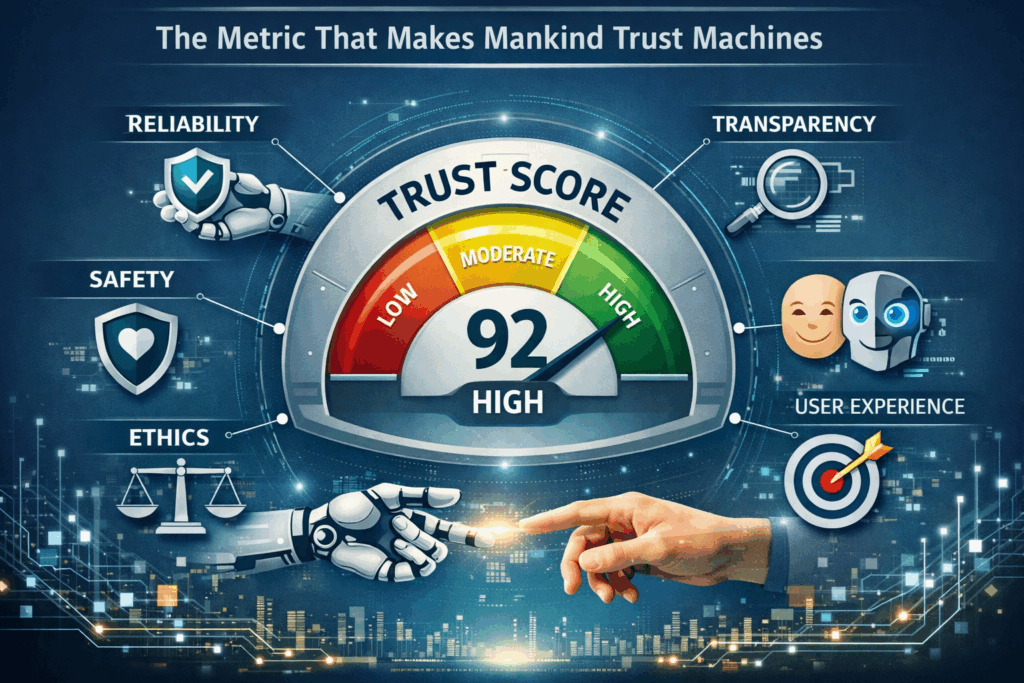
Metrics that Make Mankind to trust Machines

AI TRUST FRAMEWORK (ATF) By lakshminarasimhan santhanam Iyengar,  Mentor@QAF Lab India As AI systems generate ever more fluent text, “AI slop” has emerged as a term for output that reads well but is low-quality, unverified, or misleading. Such slop content – generic, citation-free text filled with surface-level claims or even hallucinated details – can erode user trust. To increase human trust in AI systems, developers are proposing metrics that make slop observable, reduce the human burden of fact-checking, and support better trust calibration through transparency and confidence signaling. Below, we survey key metrics (grounded in recent research and industry practice) aligned to an “Anti-Slop” framework, covering: (1) measuring slop, (2) human verification costs, and (3) output trustworthiness/transparency. 1. Measuring “Slop” in AI Outputs AI slop generally refers to a flood of generic, unverified AI-generated content that prioritizes quantity over quality. To systematically identify or quantify “sloppy” outputs, researchers have defined interpretable metrics that flag telltale signs of low-quality or fabricated content: Information/Claim Density: Sloppy text often packs in numerous factual-sounding claims without substance. Factual Claim Density (FCD) is one proposed metric counting how many statements appear to assert verifiable facts per 100 words. A higher claim density can indicate more opportunities for error, making slop easier to spot. Example: An answer that rattles off many specific “facts” (dates, statistics, quotes) has high FCD – if these aren’t all validated, trust should drop. Conversely, lowering FCD (fewer unsupported facts) can mitigate hallucinations. In a similar vein, information density measures the ratio of meaningful content to filler: truly sloppy passages tend to be verbose yet say little of value. Researchers compute this via token entropy or idea density – low information density (lots of words but little new information) is a strong slop indicator. Redundancy & Genericness: AI slop often features repetition and template-like prose (e.g. the same stock phrases or generic statements that “could apply in almost any context”). Metrics like lexical diversity or compression ratio can capture how repetitive an output is. High redundancy signals low originality, often correlating with content that was cheaply auto-generated. Generic answers that stay vague and avoid specifics can also be flagged – they may feel coherent but dodge providing verifiable detail, another slop tactic. For instance, Shaib et al. (2025) note that verbose answers full of broad, non-specific statements are a hallmark of slop. Measuring the proportion of vague or boilerplate sentences thus helps quantify sloppiness. Unverifiable Claims & Hallucinations: Perhaps the clearest sign of slop is factual unverifiability – claims that cannot be confirmed by any reliable source. Metrics here include hallucination rate, defined as the percentage of outputs containing at least one unsupported claim. Automated pipelines now use retrieval or fact-checking models to assess each answer: e.g. a “claim grounding check” can be done by re-querying a verifier model on each sentence to ask if it’s supported by provided sources. An elevated hallucination rate or a high unsupported claim density (unsupported claims per 100 answers) directly quantifies the slop in a system’s output. Failure mode: A model might produce a very detailed-sounding answer that is entirely invented; by counting how many such unsupported details slip through, teams can track slop reduction efforts over time (with a goal of driving the hallucination rate down, e.g. <5% of answers with any unsupported claim). Citation Quality and Support: Requiring AI to show its sources makes slop far more observable. Sloppy content is typically “citation-free” or uses irrelevant references, whereas trustworthy output should link each significant claim to a verifiable source. New metrics from retrieval-augmented generation (RAG) evaluations explicitly score citation precision (what fraction of cited sources truly support the claims) and citation coverage (what fraction of the answer’s statements are backed by the provided citations). High citation precision and coverage mean the model’s claims are well-supported by evidence on average, boosting trust; low scores reveal that many claims are unsourced or improperly sourced (a red flag). In practice, source-attribution checks are being built into editorial pipelines – for example, requiring every factual claim to include a footnote or URL and then auditing whether those links actually verify the text. Enforcing this not only catches hallucinations but deters them: “unsupported claims become visible and auditable” when every statement is expected to map to a citation. This makes it much harder for slop to hide. Specificity Risk Flags: While slop is often overly generic, another failure mode is spurious over-specificity – i.e. the model confidently adds extra details not in source material. For example, a hallucinated answer might insert a precise statistic or a proper name to sound convincing (“In 2022, 47.3% of X…”), even though no such detail was provided. Some frameworks propose flagging high-specificity content for verification, on the premise that the more specific a claim, the easier it is to check – or to catch if false. One approach is to count the number of entities, dates or numeric figures in an answer as a “specificity score”; unusually specific answers, especially absent citations, carry higher factuality risk. In essence, when an LLM goes beyond the given information to provide granular facts, that “extra specificity” is a risk signal that might warrant an automatic caution or human review. While not yet a standardized metric in academic literature, this idea aligns with check-worthy claim detection research – identifying which statements “appear to assert something factual” and thus merit fact-checking. In practice, pairing specificity flags with retrieval can mitigate slop: if the model gives a highly detailed answer, the system can be tuned to either provide a source for each detail or explicitly abstain from unsupported specifics. Use cases: These slop-focused metrics are being tested in both research settings and production. For instance, Shaib et al. (2025) developed a “slop taxonomy” and showed that human judgments of sloppiness correlate with factors like low information density, irrelevance, and factual errors. On the industry side, developers of knowledge assistants track unsupported claim rates and tune models to reduce them (e.g. via retrieval or by penalizing high FCD in

Participant at an Amazon AI Conclave taking a selfie in front of a chalkboard filled with AI concepts and notes.
Artificial Intelligence, Career in Enterprise AI, Enterprise Transformation

Mastering Enterprise AI Transformation: A Comprehensive Guide

Enterprise AI transformation is often discussed as a technology upgrade. In practice, it is an organizational redesign problem with technology as one input. Many initiatives fail not because models underperform, but because enterprises misidentify what must change. This guide clarifies what enterprise AI transformation actually entails, why most efforts stall, and how organizations can approach AI as a durable capability rather than a sequence of pilots. 1. What Enterprise AI Transformation Is (and Is Not) What it is not: Deploying chatbots or copilots in isolation Migrating workloads to GPUs without governance Running disconnected “AI innovation” labs What it is: Enterprise AI transformation is the systematic reconfiguration of decision-making, workflows, infrastructure, and accountability so that machine intelligence becomes a reliable, governed input to core business operations. At scale, AI is not a feature. It is a general-purpose capability—closer to electrification or digitization than to traditional IT projects. 2. Why Most Enterprise AI Initiatives Fail Across industries, failures cluster around the same structural issues: Use-case fixation without system readiness Teams optimize for demos instead of operational integration. Model-first thinking Organizations invest in models before establishing data quality, evaluation standards, or rollback authority. Fragmented ownership AI sits between IT, data teams, compliance, and business units—owned by none, constrained by all. Lack of decision governance No clear answers to: Who approves deployment? Who absorbs risk? Who can shut a system down? These are not technical failures. They are institutional ones. 3. The Five Dimensions of Enterprise AI Transformation A comprehensive transformation spans five tightly coupled dimensions. a) Strategy and Intent AI must be anchored to explicit business intent: Which decisions should AI inform or automate? What outcomes matter—speed, accuracy, resilience, cost, or reach? Which risks are acceptable, and which are not? Without intent, AI becomes directionless optimization. b) Data and Knowledge Architecture Enterprise AI depends less on raw volume and more on semantic coherence: Data lineage and trust Domain definitions Feedback loops from outcomes back into models Garbage data does not just degrade performance—it erodes institutional confidence. c) Infrastructure and Platforms AI infrastructure is not neutral plumbing. Choices here encode constraints: Centralized vs. federated compute Cloud vs. on-prem vs. hybrid Latency, cost, and sovereignty trade-offs Infrastructure decisions shape what kinds of intelligence are feasible. d) Governance and Risk Every deployed model is a policy decision: Evaluation criteria and benchmarks Bias, safety, and compliance checks Human override and escalation paths Strong governance does not slow AI. It prevents catastrophic reversals. e) People and Operating Model The scarcest resource is not compute—it is systems thinkers: Leaders who understand trade-offs across layers Operators who can work with probabilistic systems Institutions that reward judgment, not blind automation AI maturity correlates more with organizational learning capacity than with tooling. 4. From Pilots to Platforms: The Maturity Curve Enterprise AI adoption typically progresses through four stages: Experimentation – isolated proofs of concept Operationalization – models embedded into workflows Platformization – shared data, tooling, and standards Institutionalization – AI as a governed, trusted capability Most organizations stall between stages 2 and 3. The leap requires executive ownership, not better models. 5. Measuring Success in Enterprise AI Traditional IT metrics are insufficient. Mature organizations track: Decision latency and quality Error recovery and rollback speed Human trust and adoption Regulatory and reputational exposure Cost of failure, not just cost of compute If AI cannot fail safely, it cannot scale responsibly. 6. The Competitive Reality In the coming decade, advantage will not accrue to enterprises with: The largest models The most GPUs The loudest AI narratives It will accrue to those that can align intelligence with intent, operate under uncertainty, and evolve their institutions as fast as their technology. Enterprise AI transformation is not about replacing humans. It is about redesigning how humans and machines decide together. Conclusion Mastering enterprise AI transformation requires abandoning the myth that AI success is primarily technical. It is strategic, organizational, and cultural. Technology expands the space of what is possible. Institutions determine what becomes real. Enterprises that understand this distinction will not merely adopt AI—they will shape its outcomes. If you want, I can next: Optimize this for Yoast (green score) Create a short executive summary for LinkedIn or email Convert this into a pillar page with internal-link strategy Add India / enterprise-specific case framing Just tell me what to adapt or sharpen.

Abstract golden light arcs and interconnected nodes on a dark background, symbolizing artificial intelligence, data flow, and emerging technological intelligence.
Artificial Intelligence, Career in Enterprise AI, Enterprise Transformation

Is artificial intelligence (ai) tech stuff?

AI Is Not Tech Stuff. AI Is Everyone’s Stuff. The biggest misunderstanding about AI comes from people who assume it belongs solely to engineers. They treat it like a machine-learning terrarium maintained by technical custodians. But AI is not a discipline living inside the server rack; it is a capability that spills into every domain that deals with thinking, deciding, creating, judging, persuading, predicting, negotiating, or interpreting. When the printing press emerged, literacy stopped being a monk’s privilege. When the personal computer arrived, computation stopped being a laboratory artifact. When AI matures, reasoning itself becomes democratized. AI is no longer limited to: – data science labs – coding environments – hardware accelerators – algorithmic sandboxes It is shaping: – policy decisions – HR evaluations – curriculum design – legal drafting – medical triage – strategic consulting – marketing narratives – financial risk assessments – product innovation – creative writing – intellectual workflows If you can think, you can use AI. If you can ask a question, you can direct AI. If you can critique an answer, you can improve AI. Notice the pattern of technological evolution: machines replaced muscle, not the worker computers replaced arithmetic, not the analyst AI replaces procedural cognition, not human judgment The real advantage no longer belongs to the human with technical syntax. It belongs to the human with conceptual clarity. There are two kinds of professionals emerging: The Technical Operator: “I know how the model works.” The Cognitive Orchestrator: “I know what the model is for.” The first handles parameters. The second handles purpose. And purpose is where leadership lives. AI does not ask: “Can you code?” It asks: “Can you define value?” “Can you ask sharp questions?” “Can you constrain a system with correct assumptions?” “Can you evaluate outcomes with discernment?” The future differentiator is not computational skill. It’s epistemic judgment. People who think AI is “tech stuff” are like early-telephone skeptics who insisted that communication infrastructure was a domain for telegraph engineers. They missed the transformation at the human layer. AI is not about writing models. It’s about rewriting abilities. It upgrades: – curiosity – productivity – creativity – capability – cognition – decision quality And the irony is simple: Those who treat AI as technology will end up working for those who treat AI as leverage. The real power is not in understanding how AI functions, but in understanding how AI amplifies human intent. This is not a tool for technocrats—it is a multiplier for everyone who thinks, imagines, and leads. 1. Jobs that do tasks will decline. Anything procedural, repetitive, or rules-based is on the automation conveyor belt. Examples: data entry simple accounting routine customer support basic QA testing standard market analysis report summarisation manual scheduling form-based legal drafting If your job can be described as: “apply known rules to known inputs to produce known outputs” — it’s at risk. Machines excel at procedural predictability. 2. Jobs that direct cognition will explode. These leverage human meta-skills: steering, contextualizing, validating, and decision-framing. Growing roles: – AI strategy and orchestration – Transformation analysts – Human-in-the-loop supervisors – AI model evaluators – Prompt engineers evolve into thought architects – Ethical interpreters & bias auditors – Cross-functional synthesizers – Domain + AI integrators The winners are those who specialize in coordination over computation. 3. The key professional currency: cognitive leverage From the image: Analytical thinking Systems thinking Creativity Technological literacy Leadership and influence Resilience and adaptability Empathy and active listening Notice something: These are not “technical” skills. These are human strategic skills. The premium shifts from: knowing how → to knowing why operating tools → to orchestrating outcomes being the worker → to being the multiplier 4. AI doesn’t eliminate jobs — it eliminates functions within jobs Doctors won’t be replaced. But diagnosis pattern recognition will be. Lawyers won’t be replaced. But precedent analysis will be. Teachers won’t be replaced. But knowledge transmission will be. The value remains in judgement, relationship, narrative, interpretation. 5. Career advice: adapt like an economist, not like an engineer Don’t optimize for skills that get cheaper by the year. Optimize for skills that get rarer by the year. Cheap skills: memorization routine synthesis surface-level writing procedural analysis structured reporting Increasingly valuable skills: framing the right problem challenging assumptions contextual interpretation defining success metrics persuading stakeholders navigating ambiguity 6. The future worker is augmented, not replaced Humans + AI > AI alone Humans + AI > humans alone The highest-earning professionals of 2035 will be those who: work with AI think above AI decide about AI and outperform peers because of AI 7. The brutal conclusion In an AI-permeated future: The biggest risk is not being replaced by AI. The biggest risk is being replaced by a human who uses AI better than you do. You don’t compete with the machine. You compete with the augmented human. The Hidden Economics of Artificial Intelligence We are living through a strange inversion of value. For most of human history, knowledge was expensive to obtain and cheap to store. Books cost gold; copying them cost labor; access to scholars required privilege. Today, the situation has flipped: knowledge is cheap to obtain and expensive to verify. Ask a modern student to “research something” and they will produce 30 links, 12 PDFs, and 4000 words of comfortably confident nonsense—half-true, half-wrong, and never audited. The problem is not the absence of information; it’s the collapse of epistemic discipline. What we call intelligence tools—LLMs, embeddings, retrieval networks—are quietly transforming into cognitive infrastructure. They are no longer just “assistants”; they are becoming the substrate through which we think, write, and reason. And like all infrastructure, their impact is economic before it is philosophical. Consider a simple contrast. Historically: cost of obtaining knowledge > cost of trusting it. Now: cost of obtaining knowledge ≈ zero cost of trusting knowledge → extremely high We have lowered the sourcing cost, but not the authentication cost. Enter a new professional archetype: the verifier. People who understand: – provenance of data – integrity

Quality Learning Initiative Blog Image
Career in Enterprise AI

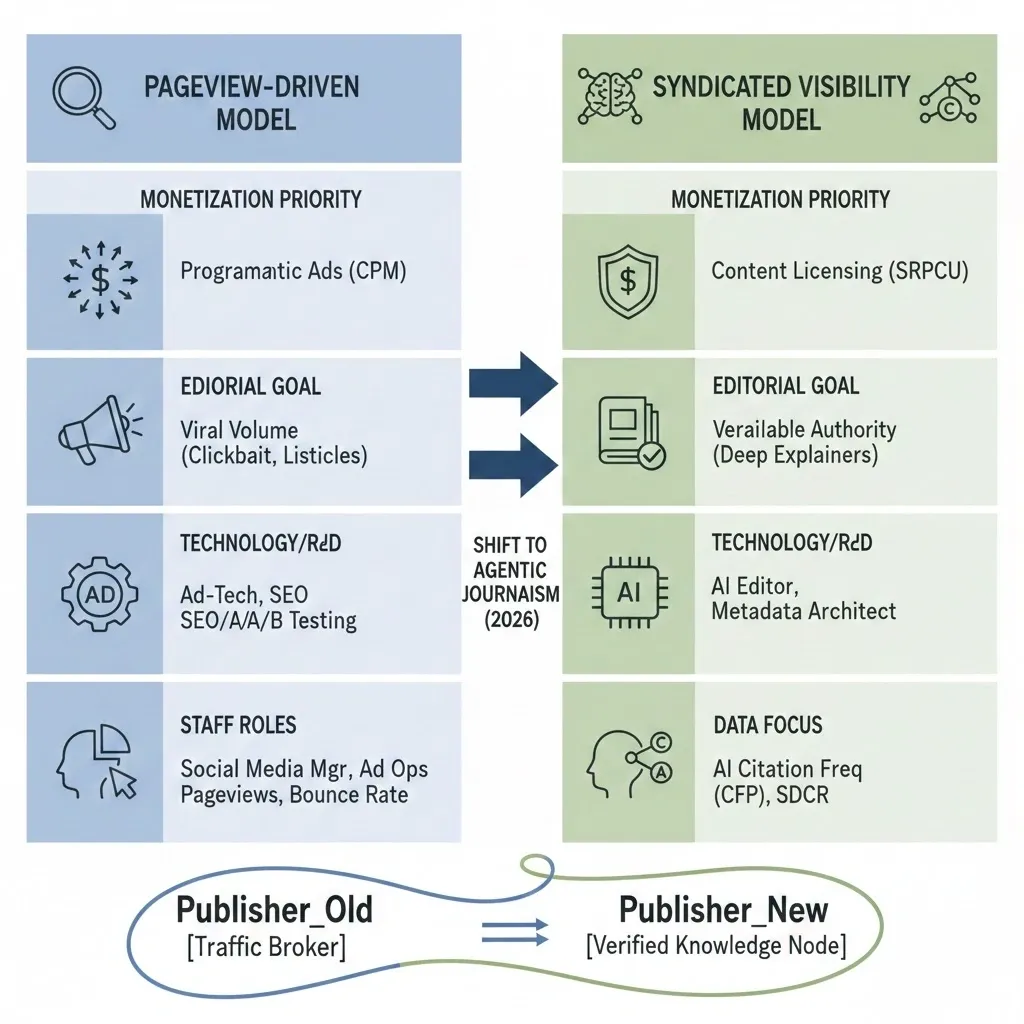
The Era of Syndicated Visibility: Agentic (AI) Journalism.

Why being quoted by machines, not clicked by humans, will decide the future of news Introduction: When the Click Stopped Being the Unit of Truth For nearly three decades, the economics of digital journalism rested on a deceptively simple assumption: if you could attract attention, you could monetise it. Pageviews became the proxy for relevance, clicks the proxy for value, and referral traffic the proxy for power. News organisations learned to live and die by dashboards that counted sessions, bounce rates, and organic search volume. The homepage was king. The article URL was the atomic unit of distribution. That world is now ending—not with a dramatic collapse, but with a quiet erosion. The defining shift of late 2025 is not that artificial intelligence can now summarise the news. That was inevitable. Nor is it that search engines are changing how results are presented. They always do. The real rupture is subtler and more consequential: Journalism is being consumed increasingly without being visited. Readers are no longer required to enter a publisher’s site to encounter its reporting. They meet journalism inside AI-generated answers—compressed, reassembled, contextualised, and presented as part of a larger synthetic response. The article still exists, but the user session does not. In this new environment, the primary question for a newsroom is no longer “How many people came to us?” but rather: “How often, how prominently, and how accurately were we quoted by the machines that now mediate knowledge?” This is what we mean by syndicated visibility—sometimes called quoted-by-AI visibility. It is the emerging metric of success in an ecosystem where visibility flows through intermediaries that do not hand over traffic in proportion to value extracted. The implications are profound. Journalism is returning, in a transformed guise, to a model that predates the web: syndication. But unlike wire services of the 20th century, this syndication is algorithmic, opaque, and global by default. And unlike the old world, where syndication was a supplement to direct readership, here it is fast becoming the main channel. This essay argues that syndicated visibility is not a buzzword or a temporary adaptation. It is the structural logic of news distribution in the AI era. Understanding it—measuring it, optimising for it, and governing it—will determine whether journalism remains a viable public institution or dissolves into an uncredited input layer for machine intelligence. I. The End of the Click-Centric World 1. The slow death of referral traffic Search once delivered readers to publishers in abundance. That bargain—content in exchange for visibility—was never entirely fair, but it was stable enough to build an industry around. SEO became a craft, then a science, then a pathology. Entire editorial strategies were shaped by keyword demand curves and Google’s shifting incentives. AI summaries have broken this equilibrium. By late 2025, multiple independent datasets—industry reports, academic studies, and browser-level behavioural analyses—converged on the same conclusion: when an AI-generated answer appears, users are significantly less likely to click through to source websites. In some categories, the decline is modest; in others, catastrophic. But the direction is unambiguous. More importantly, zero-click consumption has become normal behaviour. Users are no longer dissatisfied when they do not visit a publisher. They believe they have already “read the news” because an answer has been rendered complete at the interface level. This is not a failure of journalism. It is a triumph of interface design. 2. Why “better headlines” will not save you Many newsrooms initially responded with familiar instincts: optimise headlines, tighten summaries, improve metadata, hope to win back clicks. This misunderstands the nature of the shift. AI answers are not competing with articles in the way one headline competes with another. They are replacing the act of browsing itself. The user is no longer choosing between links; the system is choosing on their behalf what to incorporate, compress, and present. In that environment, marginal improvements in click-through rates are irrelevant. The competition has moved upstream—from user attention to machine selection. II. Defining Syndicated Visibility 1. What it is—and what it is not Syndicated visibility refers to a publisher’s success inside AI-mediated responses, not outside them. It captures three core dimensions: This is not traditional syndication. There is no explicit contract for each instance of reuse. There is no negotiated placement or guaranteed audience. And there is often no click. But functionally, it serves the same role: your journalism circulates beyond your owned surfaces, embedded in other products, generating value you do not fully control. 2. Why “quoted-by-AI” matters more than “ranked on Google” In the classic search era, ranking first meant visibility. In the AI era, being quotable matters more than being rankable. AI systems prefer sources that are: This subtly but decisively favours certain kinds of journalism: explanatory reporting, primary-source analysis, investigative work with clear evidentiary chains. It disfavors content optimised purely for novelty or outrage without grounding. This is not necessarily a moral victory—but it is a structural one. III. Why Syndicated Visibility Emerged in 2025 (Not Earlier) 1. The maturation of AI interfaces Earlier AI systems could generate text, but they were unreliable narrators. Publishers could plausibly dismiss them as toys, plagiarism engines, or hallucination factories. That dismissal is no longer credible. By late 2025, AI-generated answers have become: The shift crossed a threshold from experimentation to infrastructure. 2. The collapse of the “drive traffic, then monetise” loop The old model assumed a linear flow: Search → Article → Engagement → Revenue AI breaks this loop: Search → Answer → Satisfaction → Exit The article may be present, but the loop no longer passes through the publisher’s site. Once that loop breaks at scale, traffic ceases to be a reliable proxy for impact. Syndicated visibility fills that void. It is not a perfect replacement—but it is the only metric that corresponds to where journalism is actually being consumed. IV. The New KPI Stack in Newsrooms 1. From clicks to citations Forward-looking publishers are already shifting internal dashboards away from raw traffic metrics and toward indicators such as: This is not an abandonment of audience measurement. It is an acknowledgment that the location of audience contact has

Career in Enterprise AI

40 Hottest AI Roles that CETA and CABA Members fit

1. AI Prompt Engineer / LLM Interaction Designer Role Overview The Prompt Engineer / LLM Interaction Designer is responsible for engineering reliable, controllable, and task-effective interactions between humans, systems, and large language models. The role focuses on translating ambiguous user intent and business requirements into structured prompts, schemas, and interaction flows that yield predictable, evaluable outputs across contexts and workloads. This is not copywriting. It is applied interface engineering for probabilistic systems. Pre-requisite Qualification Experience Mandatory Skills Nice to Have Skills 2. LLM Application Engineer Role Overview The LLM Application Engineer builds production-grade applications where LLMs are embedded as functional components, not demos or chat toys. The role sits at the intersection of backend engineering, AI integration, and product logic—responsible for turning model capabilities into reliable, scalable, and testable software systems. This role exists because LLMs alone do nothing useful. Value is created only when they are orchestrated with APIs, data stores, business rules, and user workflows. Pre-requisite Qualification Experience Mandatory Skills Nice to Have Skills 3. AI Workflow Automation Engineer Role Overview The AI Workflow Automation Engineer designs and implements end-to-end automated workflows where LLMs, tools, and enterprise systems operate together with minimal human intervention. The role focuses on replacing brittle, rule-based automation with adaptive, AI-driven process execution that can handle ambiguity, exceptions, and evolving inputs. This is not RPA with prompts. It is AI-native orchestration across systems, data, and decisions. Pre-requisite Qualification Experience Mandatory Skills Nice to Have Skills 4. No-Code / Low-Code AI Automation Specialist Role Overview The No-Code / Low-Code AI Automation Specialist enables rapid deployment of AI-powered automations using visual, declarative, and configuration-driven platforms. The role focuses on time-to-value, allowing non-engineering teams to leverage LLMs and AI services safely within predefined guardrails. This role is not about bypassing engineering. It is about operationalizing AI at scale without writing full custom systems, under architectural and governance constraints.

Scroll to Top