
AI Is Not Tech Stuff. AI Is Everyone’s Stuff.
The biggest misunderstanding about AI comes from people who assume it belongs solely to engineers. They treat it like a machine-learning terrarium maintained by technical custodians. But AI is not a discipline living inside the server rack; it is a capability that spills into every domain that deals with thinking, deciding, creating, judging, persuading, predicting, negotiating, or interpreting.
When the printing press emerged, literacy stopped being a monk’s privilege. When the personal computer arrived, computation stopped being a laboratory artifact. When AI matures, reasoning itself becomes democratized.
AI is no longer limited to: – data science labs – coding environments – hardware accelerators – algorithmic sandboxes
It is shaping: – policy decisions – HR evaluations – curriculum design – legal drafting – medical triage – strategic consulting – marketing narratives – financial risk assessments – product innovation – creative writing – intellectual workflows
If you can think, you can use AI. If you can ask a question, you can direct AI. If you can critique an answer, you can improve AI.
Notice the pattern of technological evolution:
- machines replaced muscle, not the worker
- computers replaced arithmetic, not the analyst
- AI replaces procedural cognition, not human judgment
The real advantage no longer belongs to the human with technical syntax. It belongs to the human with conceptual clarity.
There are two kinds of professionals emerging:
The Technical Operator: “I know how the model works.” The Cognitive Orchestrator: “I know what the model is for.”
The first handles parameters. The second handles purpose.
And purpose is where leadership lives.
AI does not ask: “Can you code?” It asks: “Can you define value?” “Can you ask sharp questions?” “Can you constrain a system with correct assumptions?” “Can you evaluate outcomes with discernment?”
The future differentiator is not computational skill. It’s epistemic judgment.
People who think AI is “tech stuff” are like early-telephone skeptics who insisted that communication infrastructure was a domain for telegraph engineers. They missed the transformation at the human layer.
AI is not about writing models. It’s about rewriting abilities.
It upgrades: – curiosity – productivity – creativity – capability – cognition – decision quality
And the irony is simple: Those who treat AI as technology will end up working for those who treat AI as leverage.
The real power is not in understanding how AI functions, but in understanding how AI amplifies human intent. This is not a tool for technocrats—it is a multiplier for everyone who thinks, imagines, and leads.
1. Jobs that do tasks will decline.
Anything procedural, repetitive, or rules-based is on the automation conveyor belt.
Examples: data entry simple accounting routine customer support basic QA testing standard market analysis report summarisation manual scheduling form-based legal drafting
If your job can be described as: “apply known rules to known inputs to produce known outputs” — it’s at risk.
Machines excel at procedural predictability.
2. Jobs that direct cognition will explode.
These leverage human meta-skills: steering, contextualizing, validating, and decision-framing.
Growing roles: – AI strategy and orchestration – Transformation analysts – Human-in-the-loop supervisors – AI model evaluators – Prompt engineers evolve into thought architects – Ethical interpreters & bias auditors – Cross-functional synthesizers – Domain + AI integrators
The winners are those who specialize in coordination over computation.
3. The key professional currency: cognitive leverage
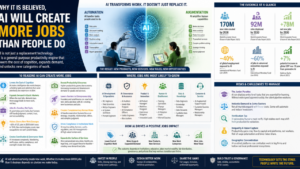
From the image: Analytical thinking Systems thinking Creativity Technological literacy Leadership and influence Resilience and adaptability Empathy and active listening
Notice something: These are not “technical” skills. These are human strategic skills.
The premium shifts from: knowing how → to knowing why operating tools → to orchestrating outcomes being the worker → to being the multiplier
4. AI doesn’t eliminate jobs — it eliminates functions within jobs
Doctors won’t be replaced. But diagnosis pattern recognition will be.
Lawyers won’t be replaced. But precedent analysis will be.
Teachers won’t be replaced. But knowledge transmission will be.
The value remains in judgement, relationship, narrative, interpretation.
5. Career advice: adapt like an economist, not like an engineer
Don’t optimize for skills that get cheaper by the year. Optimize for skills that get rarer by the year.
Cheap skills: memorization routine synthesis surface-level writing procedural analysis structured reporting
Increasingly valuable skills: framing the right problem challenging assumptions contextual interpretation defining success metrics persuading stakeholders navigating ambiguity
6. The future worker is augmented, not replaced
Humans + AI > AI alone Humans + AI > humans alone
The highest-earning professionals of 2035 will be those who: work with AI think above AI decide about AI and outperform peers because of AI
7. The brutal conclusion
In an AI-permeated future: The biggest risk is not being replaced by AI. The biggest risk is being replaced by a human who uses AI better than you do.
You don’t compete with the machine. You compete with the augmented human.
The Hidden Economics of Artificial Intelligence
We are living through a strange inversion of value. For most of human history, knowledge was expensive to obtain and cheap to store. Books cost gold; copying them cost labor; access to scholars required privilege. Today, the situation has flipped: knowledge is cheap to obtain and expensive to verify.
Ask a modern student to “research something” and they will produce 30 links, 12 PDFs, and 4000 words of comfortably confident nonsense—half-true, half-wrong, and never audited. The problem is not the absence of information; it’s the collapse of epistemic discipline.
What we call intelligence tools—LLMs, embeddings, retrieval networks—are quietly transforming into cognitive infrastructure. They are no longer just “assistants”; they are becoming the substrate through which we think, write, and reason. And like all infrastructure, their impact is economic before it is philosophical.
Consider a simple contrast.
Historically: cost of obtaining knowledge > cost of trusting it.
Now: cost of obtaining knowledge ≈ zero cost of trusting knowledge → extremely high
We have lowered the sourcing cost, but not the authentication cost.
Enter a new professional archetype: the verifier.
People who understand: – provenance of data – integrity of sources – statistical validity – logical coherence – bias detection – model hallucination exposure – adversarial prompting – auditability
These are becoming as valuable as the knowledge creators.
There is also a deeper shift: the burden of comprehension is shifting from the reader to the system. We are outsourcing understanding the way past civilizations outsourced memory.
Once, we used libraries as extensions of memory. Now, we use AI systems as extensions of reasoning.
That raises uncomfortable questions: When a machine drafts an argument we merely approve, are we thinking—or just curating? When conclusions are machine-generated, is the human still the author or merely the signature?
The next intellectual elite will not be defined by how much they know, but by:
- what they choose not to delegate
- what they insist on understanding directly
- what cognitive tasks they refuse to outsource
A person who knows everything through an AI knows nothing independently. A person who understands how the AI reasons is never intellectually displaced.
The economic advantage goes not to the one with infinite informational access, but to the one with discriminatory cognition—the ability to separate signal from noise, truth from plausibility, explanation from justification.
So the real question for the emerging knowledge economy is not: “How much can I ask the machine to do?”
But: “What must I preserve as mine?”
Because the moment we give up the ability to examine reasoning, we risk becoming consumers of conclusions, rather than producers of thought.
And that is the real fault line of the coming era.
Let me know your view, write to sln2737@gmail.com.