Enterprise Transformation

Describes about Enterprise Transformation Using AI

Artificial Intelligence, Career in Enterprise AI, Enterprise Transformation

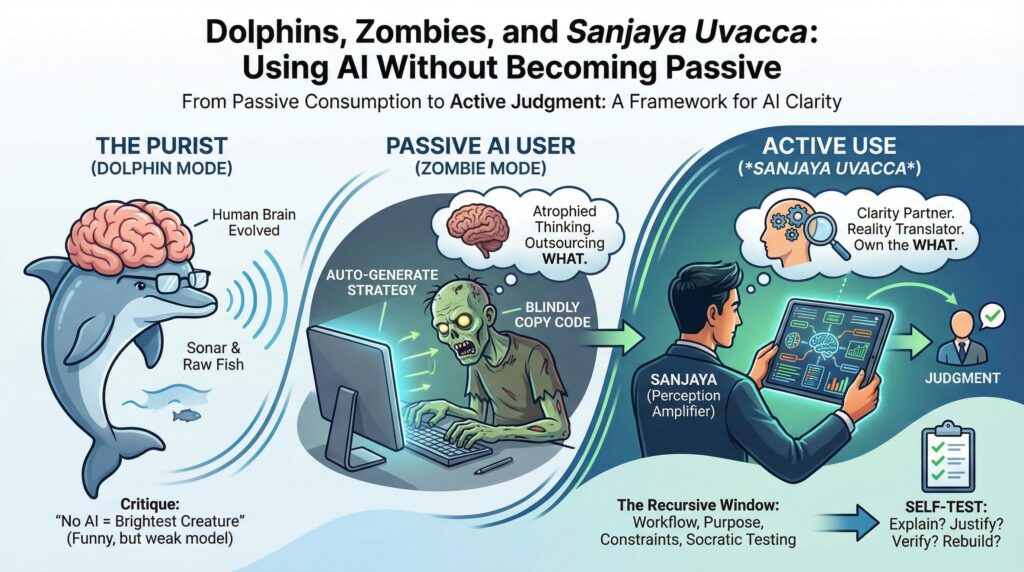
Dolphins, Zombies, and Sanjaya Uvacca: Using AI Without Becoming Passive

When people are substituting mankind with machinekind, there are certain collateral damage happens. It is quite normal, luddites of AI era, have been on the rise. Here what is being claimed, the changes in the structure of brain. New anatomical evidence reveals the shocking difference between AI users and AI purists. According to a rigorous scientific diagram, if you strictly refuse to use LLMs, your brain doesn’t merely remain human. It evolves into a massive, highly complex organ capable of sonar and eating raw fish. You basically become a bottlenose dolphin. 🐬 Some critics kind of imply: “Those who don’t use AI are dolphins: the brightest and smartest creatures swimming among us ChatGPT zombies.” Funny line. Weak model. Because the real dividing line isn’t AI vs no AI. It’s passive use vs active use. Let me show you the anatomy of the Nueral Machine ( Machine Brain). And Credits: Graphcore. Apply for 500+ Semiconductor jobs in Graphcore, Bangalore. Graphcore, now a wholly owned subsidiary of SoftBank Group, will invest up to £1 billion over a decade to establish an AI Engineering Campus in Bengaluru. The plan targets ~500 semiconductor jobs, with ~100 roles hired immediately across silicon logic/physical design, verification, characterization, and bring-up. The expansion in India is paired with a UK headcount increase to ~750, primarily in silicon, software, and AI engineering. The campus will contribute to Graphcore’s end-to-end AI compute stack (silicon, systems, software). SoftBank’s broader AI push includes large-scale infrastructure initiatives such as Stargate, in partnership with OpenAI and Oracle. SoftBank reports >$12 billion invested in India over the past decade. Rationale (explicitly stated): Bengaluru’s concentration of universities, startups, and multinational tech talent. Alignment with Indian government semiconductor initiatives and skills development. Implications (inference, bounded): Signals deepening global semiconductor R&D presence in India, not just services. Positions Graphcore to scale AI silicon development capacity while diversifying talent geography. Reinforces SoftBank’s strategy to vertically integrate AI infrastructure—from chips to platforms. Bottom line: This is a long-horizon R&D and talent bet, anchoring advanced semiconductor engineering in India while integrating Graphcore into SoftBank’s broader AI infrastructure agenda. Career at Graphcore Director / Senior Principal AI SoC Validation (Bring-up lead)Engineering – SiliconApply now Principal Bring-Up and Characterisation EngineerEngineering – SiliconApply now Principal Embedded SW/FW Engineer (Bringup) – Bengaluru, multiple vacanciesEngineering – SiliconApply now Principal Silicon Physical Design Engineer – BengaluruEngineering – SiliconApply now Principal Silicon Verification Engineer – BengaluruEngineering – SiliconApply now Senior Bring-Up and Characterisation Engineer – BengaluruEngineering – SiliconApply now Senior Bring-Up and Characterisation Engineer – Bengaluru, Multiple VacanciesEngineering – SiliconApply now Senior Bring-Up and Characterisation Engineer – Bengaluru, Multiple VacanciesEngineering – SiliconApply now Senior Embedded SW/FW Engineer (Bringup) – Bengaluru, multiple vacanciesEngineering – SiliconApply now Senior Embedded SW/FW Engineer (Bringup), Bengaluru, multiple vacanciesEngineering – SiliconApply now Senior Silicon Physical Design Engineer – BengaluruEngineering – SiliconApply now Senior Silicon Verification EngineerEngineering – SiliconApply now Silicon Physical Design Engineer – Bengaluru, Multiple VacanciesEngineering – SiliconApply now Staff Bring-Up and Characterisation EngineerEngineering – SiliconApply now Staff Bring-Up and Characterisation Engineer – BengaluruEngineering – SiliconApply now Staff Embedded SW/FW Engineer (Bringup) – BengaluruEngineering – SiliconApply now Staff Silicon Logical Design Engineer – Bengaluru, Multiple VacanciesEngineering – SiliconApply now Staff Silicon Physical Design Engineer – BengaluruEngineering – SiliconApply now Staff Silicon Verification Engineer – Bengaluru, Multiple VacanciesEngineering – SiliconApply now The Connotation We’re Beating: “Using AI Makes You Passive” There’s truth inside the fear. If you stop exercising a muscle, it atrophies. If you use AI to replace thinking, you’ll get worse at thinking. That’s what “getting dumber” looks like in practice: blindly copy-pasting code you can’t explain, auto-generating strategy you can’t defend, letting autocomplete decide your business logic, accepting output without checking assumptions. But here’s the distinction people keep skipping: Outsourcing thought and outsourcing execution are two different things. AI can accelerate the HOW—drafting, refactoring, summarizing, exploring options. Humans must own the WHAT—what matters, what to build, what tradeoffs to accept, what “good” looks like, what you’re willing to be accountable for. Passive consumption makes you dumber. Active use makes you sharper. So how do you force active use every time? That’s where Sanjaya Uvacca comes in. Sanjaya Uvacca: Not “Just a Narrator,” But a Discipline of Clarity “Sanjaya uvāca” literally reads as “Sanjaya said…”—and it’s easy to treat that like a speaker label you skip past. But Sanjaya isn’t a decorative narrator. He’s an archetype: the lucid witness who can stand near chaos without being swallowed by it, and transmit what matters without distortion. And that gives us the cleanest metaphor for using AI well: In the Mahabharata, Sanjaya is the bridge between battle and blindness: he translates an overwhelming battlefield into clear perception for someone who cannot see it directly—without taking the choice away from him. That’s the most accurate metaphor for Artificial Intelligence. Our “battle” is complexity (information overload, shifting contexts, endless variables). Our “blindness” is cognitive (limited attention, limited time, partial knowledge). Used well, AI becomes a Sanjaya: it expands perception—summarizes, compares, surfaces risks, reveals tradeoffs—so the human can answer the harder question of what matters and what to do. Used poorly, AI stops being a bridge and becomes a crutch: it doesn’t cure blindness, it replaces judgment. So the goal is not “use AI” or “don’t use AI.” The goal is: use AI like Sanjaya. Perception amplifier. Clarity partner. Reality translator. Not a substitute decision-maker. The Recursive Window: Features That Make Passive Use Hard I don’t rely on a “magic prompt.” I rely on a workflow—a recursive window that forces thinking before output. Here are the features: 1) Start with purpose and constraints Before generating anything, the process forces you to define: what outcome you want, who it’s for, what constraints matter (time, budget, risk, tone, scope). This immediately locks you into the human job: WHAT are we trying to do? 2) Build a map before building the artifact Instead of jumping to a final answer, you first create structure: a syllabus for learning, a plan for execution, dependencies and “unknowns” made visible. This prevents the

Artificial Intelligence, Career in Enterprise AI, Enterprise Transformation

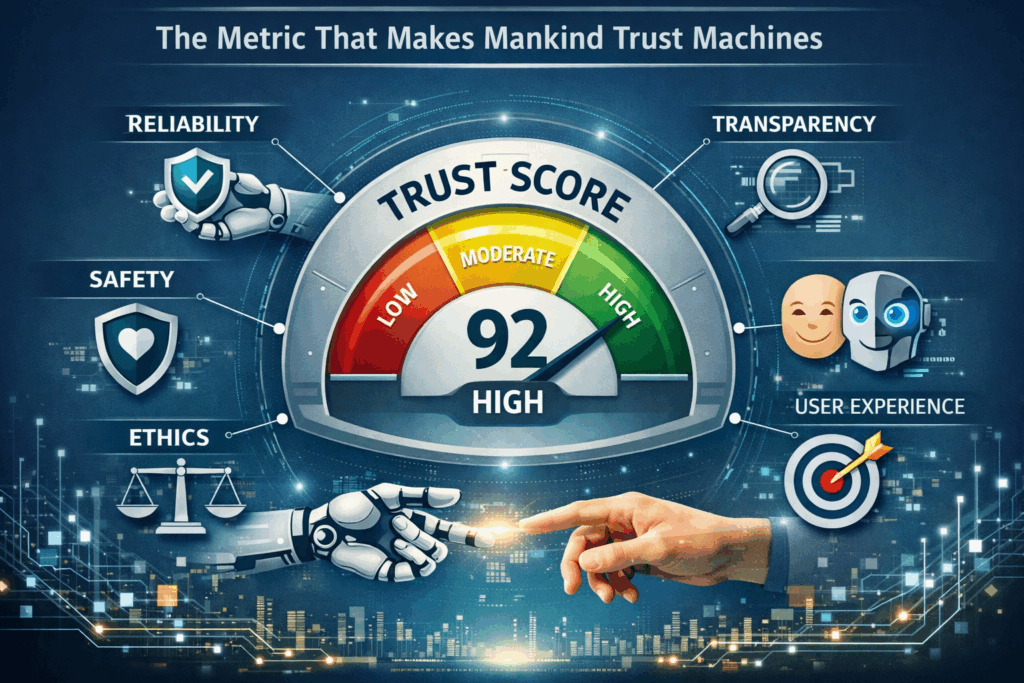
Metrics that Make Mankind to trust Machines

AI TRUST FRAMEWORK (ATF) By lakshminarasimhan santhanam Iyengar,  Mentor@QAF Lab India As AI systems generate ever more fluent text, “AI slop” has emerged as a term for output that reads well but is low-quality, unverified, or misleading. Such slop content – generic, citation-free text filled with surface-level claims or even hallucinated details – can erode user trust. To increase human trust in AI systems, developers are proposing metrics that make slop observable, reduce the human burden of fact-checking, and support better trust calibration through transparency and confidence signaling. Below, we survey key metrics (grounded in recent research and industry practice) aligned to an “Anti-Slop” framework, covering: (1) measuring slop, (2) human verification costs, and (3) output trustworthiness/transparency. 1. Measuring “Slop” in AI Outputs AI slop generally refers to a flood of generic, unverified AI-generated content that prioritizes quantity over quality. To systematically identify or quantify “sloppy” outputs, researchers have defined interpretable metrics that flag telltale signs of low-quality or fabricated content: Information/Claim Density: Sloppy text often packs in numerous factual-sounding claims without substance. Factual Claim Density (FCD) is one proposed metric counting how many statements appear to assert verifiable facts per 100 words. A higher claim density can indicate more opportunities for error, making slop easier to spot. Example: An answer that rattles off many specific “facts” (dates, statistics, quotes) has high FCD – if these aren’t all validated, trust should drop. Conversely, lowering FCD (fewer unsupported facts) can mitigate hallucinations. In a similar vein, information density measures the ratio of meaningful content to filler: truly sloppy passages tend to be verbose yet say little of value. Researchers compute this via token entropy or idea density – low information density (lots of words but little new information) is a strong slop indicator. Redundancy & Genericness: AI slop often features repetition and template-like prose (e.g. the same stock phrases or generic statements that “could apply in almost any context”). Metrics like lexical diversity or compression ratio can capture how repetitive an output is. High redundancy signals low originality, often correlating with content that was cheaply auto-generated. Generic answers that stay vague and avoid specifics can also be flagged – they may feel coherent but dodge providing verifiable detail, another slop tactic. For instance, Shaib et al. (2025) note that verbose answers full of broad, non-specific statements are a hallmark of slop. Measuring the proportion of vague or boilerplate sentences thus helps quantify sloppiness. Unverifiable Claims & Hallucinations: Perhaps the clearest sign of slop is factual unverifiability – claims that cannot be confirmed by any reliable source. Metrics here include hallucination rate, defined as the percentage of outputs containing at least one unsupported claim. Automated pipelines now use retrieval or fact-checking models to assess each answer: e.g. a “claim grounding check” can be done by re-querying a verifier model on each sentence to ask if it’s supported by provided sources. An elevated hallucination rate or a high unsupported claim density (unsupported claims per 100 answers) directly quantifies the slop in a system’s output. Failure mode: A model might produce a very detailed-sounding answer that is entirely invented; by counting how many such unsupported details slip through, teams can track slop reduction efforts over time (with a goal of driving the hallucination rate down, e.g. <5% of answers with any unsupported claim). Citation Quality and Support: Requiring AI to show its sources makes slop far more observable. Sloppy content is typically “citation-free” or uses irrelevant references, whereas trustworthy output should link each significant claim to a verifiable source. New metrics from retrieval-augmented generation (RAG) evaluations explicitly score citation precision (what fraction of cited sources truly support the claims) and citation coverage (what fraction of the answer’s statements are backed by the provided citations). High citation precision and coverage mean the model’s claims are well-supported by evidence on average, boosting trust; low scores reveal that many claims are unsourced or improperly sourced (a red flag). In practice, source-attribution checks are being built into editorial pipelines – for example, requiring every factual claim to include a footnote or URL and then auditing whether those links actually verify the text. Enforcing this not only catches hallucinations but deters them: “unsupported claims become visible and auditable” when every statement is expected to map to a citation. This makes it much harder for slop to hide. Specificity Risk Flags: While slop is often overly generic, another failure mode is spurious over-specificity – i.e. the model confidently adds extra details not in source material. For example, a hallucinated answer might insert a precise statistic or a proper name to sound convincing (“In 2022, 47.3% of X…”), even though no such detail was provided. Some frameworks propose flagging high-specificity content for verification, on the premise that the more specific a claim, the easier it is to check – or to catch if false. One approach is to count the number of entities, dates or numeric figures in an answer as a “specificity score”; unusually specific answers, especially absent citations, carry higher factuality risk. In essence, when an LLM goes beyond the given information to provide granular facts, that “extra specificity” is a risk signal that might warrant an automatic caution or human review. While not yet a standardized metric in academic literature, this idea aligns with check-worthy claim detection research – identifying which statements “appear to assert something factual” and thus merit fact-checking. In practice, pairing specificity flags with retrieval can mitigate slop: if the model gives a highly detailed answer, the system can be tuned to either provide a source for each detail or explicitly abstain from unsupported specifics. Use cases: These slop-focused metrics are being tested in both research settings and production. For instance, Shaib et al. (2025) developed a “slop taxonomy” and showed that human judgments of sloppiness correlate with factors like low information density, irrelevance, and factual errors. On the industry side, developers of knowledge assistants track unsupported claim rates and tune models to reduce them (e.g. via retrieval or by penalizing high FCD in

Participant at an Amazon AI Conclave taking a selfie in front of a chalkboard filled with AI concepts and notes.
Artificial Intelligence, Career in Enterprise AI, Enterprise Transformation

Mastering Enterprise AI Transformation: A Comprehensive Guide

Enterprise AI transformation is often discussed as a technology upgrade. In practice, it is an organizational redesign problem with technology as one input. Many initiatives fail not because models underperform, but because enterprises misidentify what must change. This guide clarifies what enterprise AI transformation actually entails, why most efforts stall, and how organizations can approach AI as a durable capability rather than a sequence of pilots. 1. What Enterprise AI Transformation Is (and Is Not) What it is not: Deploying chatbots or copilots in isolation Migrating workloads to GPUs without governance Running disconnected “AI innovation” labs What it is: Enterprise AI transformation is the systematic reconfiguration of decision-making, workflows, infrastructure, and accountability so that machine intelligence becomes a reliable, governed input to core business operations. At scale, AI is not a feature. It is a general-purpose capability—closer to electrification or digitization than to traditional IT projects. 2. Why Most Enterprise AI Initiatives Fail Across industries, failures cluster around the same structural issues: Use-case fixation without system readiness Teams optimize for demos instead of operational integration. Model-first thinking Organizations invest in models before establishing data quality, evaluation standards, or rollback authority. Fragmented ownership AI sits between IT, data teams, compliance, and business units—owned by none, constrained by all. Lack of decision governance No clear answers to: Who approves deployment? Who absorbs risk? Who can shut a system down? These are not technical failures. They are institutional ones. 3. The Five Dimensions of Enterprise AI Transformation A comprehensive transformation spans five tightly coupled dimensions. a) Strategy and Intent AI must be anchored to explicit business intent: Which decisions should AI inform or automate? What outcomes matter—speed, accuracy, resilience, cost, or reach? Which risks are acceptable, and which are not? Without intent, AI becomes directionless optimization. b) Data and Knowledge Architecture Enterprise AI depends less on raw volume and more on semantic coherence: Data lineage and trust Domain definitions Feedback loops from outcomes back into models Garbage data does not just degrade performance—it erodes institutional confidence. c) Infrastructure and Platforms AI infrastructure is not neutral plumbing. Choices here encode constraints: Centralized vs. federated compute Cloud vs. on-prem vs. hybrid Latency, cost, and sovereignty trade-offs Infrastructure decisions shape what kinds of intelligence are feasible. d) Governance and Risk Every deployed model is a policy decision: Evaluation criteria and benchmarks Bias, safety, and compliance checks Human override and escalation paths Strong governance does not slow AI. It prevents catastrophic reversals. e) People and Operating Model The scarcest resource is not compute—it is systems thinkers: Leaders who understand trade-offs across layers Operators who can work with probabilistic systems Institutions that reward judgment, not blind automation AI maturity correlates more with organizational learning capacity than with tooling. 4. From Pilots to Platforms: The Maturity Curve Enterprise AI adoption typically progresses through four stages: Experimentation – isolated proofs of concept Operationalization – models embedded into workflows Platformization – shared data, tooling, and standards Institutionalization – AI as a governed, trusted capability Most organizations stall between stages 2 and 3. The leap requires executive ownership, not better models. 5. Measuring Success in Enterprise AI Traditional IT metrics are insufficient. Mature organizations track: Decision latency and quality Error recovery and rollback speed Human trust and adoption Regulatory and reputational exposure Cost of failure, not just cost of compute If AI cannot fail safely, it cannot scale responsibly. 6. The Competitive Reality In the coming decade, advantage will not accrue to enterprises with: The largest models The most GPUs The loudest AI narratives It will accrue to those that can align intelligence with intent, operate under uncertainty, and evolve their institutions as fast as their technology. Enterprise AI transformation is not about replacing humans. It is about redesigning how humans and machines decide together. Conclusion Mastering enterprise AI transformation requires abandoning the myth that AI success is primarily technical. It is strategic, organizational, and cultural. Technology expands the space of what is possible. Institutions determine what becomes real. Enterprises that understand this distinction will not merely adopt AI—they will shape its outcomes. If you want, I can next: Optimize this for Yoast (green score) Create a short executive summary for LinkedIn or email Convert this into a pillar page with internal-link strategy Add India / enterprise-specific case framing Just tell me what to adapt or sharpen.

Abstract golden light arcs and interconnected nodes on a dark background, symbolizing artificial intelligence, data flow, and emerging technological intelligence.
Artificial Intelligence, Career in Enterprise AI, Enterprise Transformation

Is artificial intelligence (ai) tech stuff?

AI Is Not Tech Stuff. AI Is Everyone’s Stuff. The biggest misunderstanding about AI comes from people who assume it belongs solely to engineers. They treat it like a machine-learning terrarium maintained by technical custodians. But AI is not a discipline living inside the server rack; it is a capability that spills into every domain that deals with thinking, deciding, creating, judging, persuading, predicting, negotiating, or interpreting. When the printing press emerged, literacy stopped being a monk’s privilege. When the personal computer arrived, computation stopped being a laboratory artifact. When AI matures, reasoning itself becomes democratized. AI is no longer limited to: – data science labs – coding environments – hardware accelerators – algorithmic sandboxes It is shaping: – policy decisions – HR evaluations – curriculum design – legal drafting – medical triage – strategic consulting – marketing narratives – financial risk assessments – product innovation – creative writing – intellectual workflows If you can think, you can use AI. If you can ask a question, you can direct AI. If you can critique an answer, you can improve AI. Notice the pattern of technological evolution: machines replaced muscle, not the worker computers replaced arithmetic, not the analyst AI replaces procedural cognition, not human judgment The real advantage no longer belongs to the human with technical syntax. It belongs to the human with conceptual clarity. There are two kinds of professionals emerging: The Technical Operator: “I know how the model works.” The Cognitive Orchestrator: “I know what the model is for.” The first handles parameters. The second handles purpose. And purpose is where leadership lives. AI does not ask: “Can you code?” It asks: “Can you define value?” “Can you ask sharp questions?” “Can you constrain a system with correct assumptions?” “Can you evaluate outcomes with discernment?” The future differentiator is not computational skill. It’s epistemic judgment. People who think AI is “tech stuff” are like early-telephone skeptics who insisted that communication infrastructure was a domain for telegraph engineers. They missed the transformation at the human layer. AI is not about writing models. It’s about rewriting abilities. It upgrades: – curiosity – productivity – creativity – capability – cognition – decision quality And the irony is simple: Those who treat AI as technology will end up working for those who treat AI as leverage. The real power is not in understanding how AI functions, but in understanding how AI amplifies human intent. This is not a tool for technocrats—it is a multiplier for everyone who thinks, imagines, and leads. 1. Jobs that do tasks will decline. Anything procedural, repetitive, or rules-based is on the automation conveyor belt. Examples: data entry simple accounting routine customer support basic QA testing standard market analysis report summarisation manual scheduling form-based legal drafting If your job can be described as: “apply known rules to known inputs to produce known outputs” — it’s at risk. Machines excel at procedural predictability. 2. Jobs that direct cognition will explode. These leverage human meta-skills: steering, contextualizing, validating, and decision-framing. Growing roles: – AI strategy and orchestration – Transformation analysts – Human-in-the-loop supervisors – AI model evaluators – Prompt engineers evolve into thought architects – Ethical interpreters & bias auditors – Cross-functional synthesizers – Domain + AI integrators The winners are those who specialize in coordination over computation. 3. The key professional currency: cognitive leverage From the image: Analytical thinking Systems thinking Creativity Technological literacy Leadership and influence Resilience and adaptability Empathy and active listening Notice something: These are not “technical” skills. These are human strategic skills. The premium shifts from: knowing how → to knowing why operating tools → to orchestrating outcomes being the worker → to being the multiplier 4. AI doesn’t eliminate jobs — it eliminates functions within jobs Doctors won’t be replaced. But diagnosis pattern recognition will be. Lawyers won’t be replaced. But precedent analysis will be. Teachers won’t be replaced. But knowledge transmission will be. The value remains in judgement, relationship, narrative, interpretation. 5. Career advice: adapt like an economist, not like an engineer Don’t optimize for skills that get cheaper by the year. Optimize for skills that get rarer by the year. Cheap skills: memorization routine synthesis surface-level writing procedural analysis structured reporting Increasingly valuable skills: framing the right problem challenging assumptions contextual interpretation defining success metrics persuading stakeholders navigating ambiguity 6. The future worker is augmented, not replaced Humans + AI > AI alone Humans + AI > humans alone The highest-earning professionals of 2035 will be those who: work with AI think above AI decide about AI and outperform peers because of AI 7. The brutal conclusion In an AI-permeated future: The biggest risk is not being replaced by AI. The biggest risk is being replaced by a human who uses AI better than you do. You don’t compete with the machine. You compete with the augmented human. The Hidden Economics of Artificial Intelligence We are living through a strange inversion of value. For most of human history, knowledge was expensive to obtain and cheap to store. Books cost gold; copying them cost labor; access to scholars required privilege. Today, the situation has flipped: knowledge is cheap to obtain and expensive to verify. Ask a modern student to “research something” and they will produce 30 links, 12 PDFs, and 4000 words of comfortably confident nonsense—half-true, half-wrong, and never audited. The problem is not the absence of information; it’s the collapse of epistemic discipline. What we call intelligence tools—LLMs, embeddings, retrieval networks—are quietly transforming into cognitive infrastructure. They are no longer just “assistants”; they are becoming the substrate through which we think, write, and reason. And like all infrastructure, their impact is economic before it is philosophical. Consider a simple contrast. Historically: cost of obtaining knowledge > cost of trusting it. Now: cost of obtaining knowledge ≈ zero cost of trusting knowledge → extremely high We have lowered the sourcing cost, but not the authentication cost. Enter a new professional archetype: the verifier. People who understand: – provenance of data – integrity

Educational Blog Image 5
Artificial Intelligence, Enterprise Transformation

How do we transform enterprises with AI without losing ourselves?

For a century, we organised companies on industrial-age assumptions. We divided work into discrete tasks, delegated them to specialised departments, documented every step, escalated issues and hoped for alignment. This model achieved remarkable success – it built railways, airlines, global supply chains and even the foundations of the internet. However, it relied on the assumption that humans were the sole interpreters of context. When that assumption no longer holds, everything shifts. Artificial intelligence does not merely automate routine tasks; it is a much more complex system. It comprehends context, retains past events and identifies inconsistencies that humans might overlook. It integrates data from multiple systems in seconds and provides insights without requiring manual data analysis. For enterprises today, this is not merely another tool but a paradigm shift in the nature of work. A New Production Factor: Cognitive Infrastructure Consider any company we admire: each has mastered a foundational resource before others. Toyota mastered the flow of value in its factories; Amazon excelled in lightning-fast logistics; Netflix captured our attention. The next generation of leaders will master a different resource: cognitive infrastructure. This is the system that carries knowledge, context, memory and reasoning across an entire organisation. Imagine it as providing your company with a brain. For the first time an enterprise can truly “think” alongside you. Not with a single isolated bot but with a comprehensive suite of intelligence working in concert. Consider today’s AI-powered toolset, which may include a large reasoning model (such as Google’s Gemini), an AI-powered workflow builder (Google Workspace Studio), a live code-documentation engine (CodeWiki), a persistent research notebook (NotebookLM) and even on-device assistants (Gemini Nano). These are not standalone applications but collectively form a nervous system for your business. This is a new kind of infrastructure that industrial-age companies never imagined. From Process-Driven to Intelligence-Driven Organisations Many organisations have undertaken digital transformation projects that have yielded limited results. This is because most companies update tools rather than their underlying assumptions. Historically, employees were expected to perform numerous tasks simultaneously, including memorising information, locating documents, interpreting data, coordinating activities, attending meetings and manually documenting their work. These assumptions become unsustainable at scale. Artificial intelligence (AI) offers a transformative approach. An AI-augmented organisation can: – Retain information by tracking decisions and history. – Interpret data through the analysis of reports, conversations and data. – Summarise complex information into clear insights. – Monitor projects for potential issues or delays. – Connect disparate data points. – Filter and prioritise information. This shift from asking how to improve processes to what is possible when context is preserved is where true transformation begins. Knowledge Work Leaks — AI Provides a Solution Organisations often experience a knowledge leak, losing more information than they create. For example, departing employees take decades of expertise with them, key decisions are lost in chat logs and outdated documents become obsolete quickly. New hires can spend months catching up. Furthermore, critical system details are often confined to a single engineer’s memory. This creates a slow drain in collective knowledge. While new information is constantly being added, it is not always retained. AI does not eliminate all knowledge gaps but provides a second brain for the enterprise that: – Captures context in real-time. – Continuously updates itself. – Links decisions to their underlying reasons. – Explains code and policies in accessible language. – Preserves historical data without overwhelming users. For example, consider a tool like CodeWiki that generates not only static documentation but continuously tracks the evolving state of a codebase. Alternatively, Workspace Studio could treat every meeting, chat, document and task as structured signals for learning rather than isolated artefacts. Even a research assistant like NotebookLM could become a collective memory anchor, not a place for note-taking but a repository of the team’s knowledge. This is not magic; it is the result of information being retained. Agentic Workflows: Work That Moves On Its Own What depletes teams is not the creative aspect of the work but the friction surrounding it. Individuals express dissatisfaction not with problem-solving but with the pursuit of context. Consider the repetitive tasks: locating the correct file version, seeking clarifications, tracking who is obstructing whom, switching between multiple applications, copying updates between tools, requesting approvals, coordinating opinions and filling in gaps of missing context. This is what causes fatigue, not the work itself. AI agents transform the landscape. They do not eliminate work but eliminate context friction. Imagine instructing the system to: “Prepare a compliance summary using the last three customer escalations, compare it against our risk matrix and draft remediation steps. Alert the security team only if the severity exceeds threshold B.” Observe the system’s response. It gathers emails, documents and data, synthesises the relevant information, compiles the summary and only engages human experts when necessary. Humans provide judgement, not drudgery. This is not merely automation (which follows fixed rules); it is interpretation—the computer comprehends your requirements and executes them. Your enterprise becomes an orchestration engine: people define intent, AI handles the routine tasks. where do humans fit? Higher up—not out. Yes, where do humans fit? Higher up—not out. When AI takes on the heavy lifting of context, where do people go? Up. We rise to focus on what machines still struggle with: purpose, ethics, creativity, and connection. Three big roles emerge: Intent Setters. These are the leaders and visionaries who define direction with clarity and nuance. They set the goals and context — not by micromanaging tasks, but by communicating purpose. Ambiguity Navigators. These humans handle what AI can’t: empathy, ethics, conflict resolution, negotiation, and decisions under incomplete information. They interpret and adapt when the situation is fuzzy. System Shapers. These are the architects, designers, product thinkers, and transformation leads who decide how humans and AI interact. They define the guidelines, design the interfaces, and ensure the system as a whole evolves smoothly. As AI gets smarter, human judgment doesn’t become less valuable — it becomes more precious. We move from brawn to brains. Engineering Organizations: The Deepest Earthquake For engineering teams, this shift feels like a seismic event.

Artificial Intelligence, Enterprise Transformation

The Missing Layer of Huang’s Five-Layer Cake of artificial intelligence (AI) architecture

When Jensen Huang mapped the modern AI ecosystem as a “five-layer cake”—energy, chips, infrastructure, models, applications—he offered more than a metaphor. He gave the field a grammar. It allowed people to speak about AI in terms of physics and production rather than mystique. For once, the conversation returned to ground truth: megawatts, fabrication plants, fibre, training cycles. The framework travelled quickly. Policymakers adopted it. Investors reorganised theses around it. Enterprises borrowed it for strategy decks. It now circulates as a near-official diagram of the global AI race. Its clarity, however, conceals a blind spot. Huang’s layers describe how AI becomes real. They say little about why it ought to exist, for whom it is built, or under what constraints it should operate. Between the physical substrate and the applications we touch lies a missing stratum: the human architecture of AI — the intentions, judgments and institutional choices that shape every outcome but rarely appear in technical diagrams. This is not the usual refrain about “keeping humans in the loop.” It is something more structural: the role of investors, business leaders, technologists and operators as intent-setters, ambiguity navigators and system designers. Without that architecture, the AI stack becomes directionless horsepower. What the Five Layers Show — and What They Hide Huang’s model remains a useful map: Read at face value, it implies a self-contained machine: feed in capital and engineering talent, and intelligence will flow outward like electricity through a grid. But history rarely cooperates with neat diagrams. General-purpose technologies behave more like tectonic plates than appliances. They disrupt institutions, labour markets, regulatory regimes, and notions of human competence. They redistribute power before anyone is ready. The missing layer is where real decisions reside: Who sets direction? Who imagines constraints? Who absorbs uncertainty? Walk the stack from bottom to top, and the imprint of human architecture becomes obvious. Energy: Not Supply, but Civilisational Intention AI’s appetite for energy is not incremental. It is civilisational. Training frontier models and serving them at scale turn electricity into a strategic commodity, not a utility. This layer appears technical but begins with human intention. Someone decides whether a nation commits to massive build-outs of solar, wind, SMRs or grid-scale storage. Someone determines how much resilience is non-negotiable. Someone judges the trade-offs between industrial policy, climate goals and computational ambition. None of these are engineering judgments. They are institutional choices about what kind of computational civilisation we intend to build. Ambiguity enters immediately: climate volatility, regulatory shifts, geopolitical disruptions, wild variance in workload forecasts. Here the human layer becomes visible: the people who interpret uncertainty, decide which risks to tolerate, and shape energy governance accordingly. Physics offers constraints; institutions choose what to do with them. Chips: The Bottleneck Where Power Concentrates Chips are the narrowest part of the funnel — and the most political. Talk often centres on benchmarks and efficiency. But the real contest is over control of the bottleneck of intelligence production. Intentions set the trajectory: Which fabrication ecosystems to commit to for a decade? Which architectures to bet on? Which workloads to optimise for? Which failure modes are tolerable? Ambiguity is constant: export controls, vendor theatrics, supply shocks, heterogeneous fleets. Decisions must be made while the ground shifts beneath them. System shaping then determines whether firms build coherent compute governance—fair allocation, lifecycle standards, tooling that abstracts vendor differences—or collapse under fragmentation. A country may win fabs and still lose the AI century if it fails to cultivate people who can architect around uncertainty. Infrastructure: Where Ambition Meets the Real World Data centres are where plans collide with land rights, zoning laws, community sentiment, cooling limits, sovereignty regulations and budget ceilings. Huang’s contrast between three-year American build cycles and China’s overnight construction is not a boast. It is a commentary on execution culture. Again, intention precedes engineering: Where to build? How large? Owned or leased? What availability and latency promises to make? What reliability envelope to enforce? Ambiguity lurks everywhere: planning permissions, community pushback, evolving security expectations, volatile workload patterns. System shaping determines whether organisations develop mature incident reviews, coherent chargeback models, and infrastructure patterns that prevent operational drift. Infrastructure is not only concrete and fibre; it is an exam in institutional competence. Models: The Arena of Negotiated Judgment Large models are often presented as artifacts—weights, benchmarks, licensing deals. But their real nature is negotiated. Intent defines objective functions, data regimes, risk thresholds, deployment criteria. Ambiguity surrounds every evaluation: noisy benchmarks, hyped claims, emergent capabilities, domain drift, hallucinations. System shaping becomes the decisive factor: evaluation governance, red-teaming, rollback authority, documentation practices, feedback pipelines. A model is not simply a trained network. It is a social contract about acceptable behaviour under uncertainty. Applications: Where Power Touches People The top layer is where AI meets lived experience. Here the consequences of bad intent or weak governance become tangible—job displacement, degraded service quality, loss of agency, or conversely, genuine augmentation. Intent determines whether companies build tools that elevate workers or simply chase marginal cost savings. Ambiguity emerges in adoption patterns, trust deficits, unexpected failure cascades, misaligned incentives. System shaping requires rethinking workflows, guardrails, escalation paths, training regimes, and the institutional mechanisms through which users can resist harmful deployments. If this layer fails, everything below it ultimately collapses into public backlash. The Real Competition: Human Architecture, Not Compute Volume Once we acknowledge the missing layer, the global AI race looks different. China builds faster. The United States designs better chips. Europe asserts regulatory leverage. The Middle East commands energy. But the decisive question is quieter: Which societies are investing in people who can think across systems? Who is training the next generation of intent-setters, ambiguity navigators and system architects? The country with the most coders may not lead the century. The country with the most systems thinkers might. In India, the opportunity is substantial but incomplete. We produce engineers at scale. We do not yet produce enough people who can think across layers—energy to chips, chips to infrastructure, infrastructure to models, models to applications, applications to institutions. That gap is not technical. It is educational and cultural. It is the missing layer. Conclusion: Restoring Direction to the

Scroll to Top