
December 22, 2025

Educational Blog Image 5
Artificial Intelligence, Enterprise Transformation

How do we transform enterprises with AI without losing ourselves?

For a century, we organised companies on industrial-age assumptions. We divided work into discrete tasks, delegated them to specialised departments, documented every step, escalated issues and hoped for alignment. This model achieved remarkable success – it built railways, airlines, global supply chains and even the foundations of the internet. However, it relied on the assumption that humans were the sole interpreters of context. When that assumption no longer holds, everything shifts. Artificial intelligence does not merely automate routine tasks; it is a much more complex system. It comprehends context, retains past events and identifies inconsistencies that humans might overlook. It integrates data from multiple systems in seconds and provides insights without requiring manual data analysis. For enterprises today, this is not merely another tool but a paradigm shift in the nature of work. A New Production Factor: Cognitive Infrastructure Consider any company we admire: each has mastered a foundational resource before others. Toyota mastered the flow of value in its factories; Amazon excelled in lightning-fast logistics; Netflix captured our attention. The next generation of leaders will master a different resource: cognitive infrastructure. This is the system that carries knowledge, context, memory and reasoning across an entire organisation. Imagine it as providing your company with a brain. For the first time an enterprise can truly “think” alongside you. Not with a single isolated bot but with a comprehensive suite of intelligence working in concert. Consider today’s AI-powered toolset, which may include a large reasoning model (such as Google’s Gemini), an AI-powered workflow builder (Google Workspace Studio), a live code-documentation engine (CodeWiki), a persistent research notebook (NotebookLM) and even on-device assistants (Gemini Nano). These are not standalone applications but collectively form a nervous system for your business. This is a new kind of infrastructure that industrial-age companies never imagined. From Process-Driven to Intelligence-Driven Organisations Many organisations have undertaken digital transformation projects that have yielded limited results. This is because most companies update tools rather than their underlying assumptions. Historically, employees were expected to perform numerous tasks simultaneously, including memorising information, locating documents, interpreting data, coordinating activities, attending meetings and manually documenting their work. These assumptions become unsustainable at scale. Artificial intelligence (AI) offers a transformative approach. An AI-augmented organisation can: – Retain information by tracking decisions and history. – Interpret data through the analysis of reports, conversations and data. – Summarise complex information into clear insights. – Monitor projects for potential issues or delays. – Connect disparate data points. – Filter and prioritise information. This shift from asking how to improve processes to what is possible when context is preserved is where true transformation begins. Knowledge Work Leaks — AI Provides a Solution Organisations often experience a knowledge leak, losing more information than they create. For example, departing employees take decades of expertise with them, key decisions are lost in chat logs and outdated documents become obsolete quickly. New hires can spend months catching up. Furthermore, critical system details are often confined to a single engineer’s memory. This creates a slow drain in collective knowledge. While new information is constantly being added, it is not always retained. AI does not eliminate all knowledge gaps but provides a second brain for the enterprise that: – Captures context in real-time. – Continuously updates itself. – Links decisions to their underlying reasons. – Explains code and policies in accessible language. – Preserves historical data without overwhelming users. For example, consider a tool like CodeWiki that generates not only static documentation but continuously tracks the evolving state of a codebase. Alternatively, Workspace Studio could treat every meeting, chat, document and task as structured signals for learning rather than isolated artefacts. Even a research assistant like NotebookLM could become a collective memory anchor, not a place for note-taking but a repository of the team’s knowledge. This is not magic; it is the result of information being retained. Agentic Workflows: Work That Moves On Its Own What depletes teams is not the creative aspect of the work but the friction surrounding it. Individuals express dissatisfaction not with problem-solving but with the pursuit of context. Consider the repetitive tasks: locating the correct file version, seeking clarifications, tracking who is obstructing whom, switching between multiple applications, copying updates between tools, requesting approvals, coordinating opinions and filling in gaps of missing context. This is what causes fatigue, not the work itself. AI agents transform the landscape. They do not eliminate work but eliminate context friction. Imagine instructing the system to: “Prepare a compliance summary using the last three customer escalations, compare it against our risk matrix and draft remediation steps. Alert the security team only if the severity exceeds threshold B.” Observe the system’s response. It gathers emails, documents and data, synthesises the relevant information, compiles the summary and only engages human experts when necessary. Humans provide judgement, not drudgery. This is not merely automation (which follows fixed rules); it is interpretation—the computer comprehends your requirements and executes them. Your enterprise becomes an orchestration engine: people define intent, AI handles the routine tasks. where do humans fit? Higher up—not out. Yes, where do humans fit? Higher up—not out. When AI takes on the heavy lifting of context, where do people go? Up. We rise to focus on what machines still struggle with: purpose, ethics, creativity, and connection. Three big roles emerge: Intent Setters. These are the leaders and visionaries who define direction with clarity and nuance. They set the goals and context — not by micromanaging tasks, but by communicating purpose. Ambiguity Navigators. These humans handle what AI can’t: empathy, ethics, conflict resolution, negotiation, and decisions under incomplete information. They interpret and adapt when the situation is fuzzy. System Shapers. These are the architects, designers, product thinkers, and transformation leads who decide how humans and AI interact. They define the guidelines, design the interfaces, and ensure the system as a whole evolves smoothly. As AI gets smarter, human judgment doesn’t become less valuable — it becomes more precious. We move from brawn to brains. Engineering Organizations: The Deepest Earthquake For engineering teams, this shift feels like a seismic event.

Artificial Intelligence, Enterprise Transformation

The Missing Layer of Huang’s Five-Layer Cake of artificial intelligence (AI) architecture

When Jensen Huang mapped the modern AI ecosystem as a “five-layer cake”—energy, chips, infrastructure, models, applications—he offered more than a metaphor. He gave the field a grammar. It allowed people to speak about AI in terms of physics and production rather than mystique. For once, the conversation returned to ground truth: megawatts, fabrication plants, fibre, training cycles. The framework travelled quickly. Policymakers adopted it. Investors reorganised theses around it. Enterprises borrowed it for strategy decks. It now circulates as a near-official diagram of the global AI race. Its clarity, however, conceals a blind spot. Huang’s layers describe how AI becomes real. They say little about why it ought to exist, for whom it is built, or under what constraints it should operate. Between the physical substrate and the applications we touch lies a missing stratum: the human architecture of AI — the intentions, judgments and institutional choices that shape every outcome but rarely appear in technical diagrams. This is not the usual refrain about “keeping humans in the loop.” It is something more structural: the role of investors, business leaders, technologists and operators as intent-setters, ambiguity navigators and system designers. Without that architecture, the AI stack becomes directionless horsepower. What the Five Layers Show — and What They Hide Huang’s model remains a useful map: Read at face value, it implies a self-contained machine: feed in capital and engineering talent, and intelligence will flow outward like electricity through a grid. But history rarely cooperates with neat diagrams. General-purpose technologies behave more like tectonic plates than appliances. They disrupt institutions, labour markets, regulatory regimes, and notions of human competence. They redistribute power before anyone is ready. The missing layer is where real decisions reside: Who sets direction? Who imagines constraints? Who absorbs uncertainty? Walk the stack from bottom to top, and the imprint of human architecture becomes obvious. Energy: Not Supply, but Civilisational Intention AI’s appetite for energy is not incremental. It is civilisational. Training frontier models and serving them at scale turn electricity into a strategic commodity, not a utility. This layer appears technical but begins with human intention. Someone decides whether a nation commits to massive build-outs of solar, wind, SMRs or grid-scale storage. Someone determines how much resilience is non-negotiable. Someone judges the trade-offs between industrial policy, climate goals and computational ambition. None of these are engineering judgments. They are institutional choices about what kind of computational civilisation we intend to build. Ambiguity enters immediately: climate volatility, regulatory shifts, geopolitical disruptions, wild variance in workload forecasts. Here the human layer becomes visible: the people who interpret uncertainty, decide which risks to tolerate, and shape energy governance accordingly. Physics offers constraints; institutions choose what to do with them. Chips: The Bottleneck Where Power Concentrates Chips are the narrowest part of the funnel — and the most political. Talk often centres on benchmarks and efficiency. But the real contest is over control of the bottleneck of intelligence production. Intentions set the trajectory: Which fabrication ecosystems to commit to for a decade? Which architectures to bet on? Which workloads to optimise for? Which failure modes are tolerable? Ambiguity is constant: export controls, vendor theatrics, supply shocks, heterogeneous fleets. Decisions must be made while the ground shifts beneath them. System shaping then determines whether firms build coherent compute governance—fair allocation, lifecycle standards, tooling that abstracts vendor differences—or collapse under fragmentation. A country may win fabs and still lose the AI century if it fails to cultivate people who can architect around uncertainty. Infrastructure: Where Ambition Meets the Real World Data centres are where plans collide with land rights, zoning laws, community sentiment, cooling limits, sovereignty regulations and budget ceilings. Huang’s contrast between three-year American build cycles and China’s overnight construction is not a boast. It is a commentary on execution culture. Again, intention precedes engineering: Where to build? How large? Owned or leased? What availability and latency promises to make? What reliability envelope to enforce? Ambiguity lurks everywhere: planning permissions, community pushback, evolving security expectations, volatile workload patterns. System shaping determines whether organisations develop mature incident reviews, coherent chargeback models, and infrastructure patterns that prevent operational drift. Infrastructure is not only concrete and fibre; it is an exam in institutional competence. Models: The Arena of Negotiated Judgment Large models are often presented as artifacts—weights, benchmarks, licensing deals. But their real nature is negotiated. Intent defines objective functions, data regimes, risk thresholds, deployment criteria. Ambiguity surrounds every evaluation: noisy benchmarks, hyped claims, emergent capabilities, domain drift, hallucinations. System shaping becomes the decisive factor: evaluation governance, red-teaming, rollback authority, documentation practices, feedback pipelines. A model is not simply a trained network. It is a social contract about acceptable behaviour under uncertainty. Applications: Where Power Touches People The top layer is where AI meets lived experience. Here the consequences of bad intent or weak governance become tangible—job displacement, degraded service quality, loss of agency, or conversely, genuine augmentation. Intent determines whether companies build tools that elevate workers or simply chase marginal cost savings. Ambiguity emerges in adoption patterns, trust deficits, unexpected failure cascades, misaligned incentives. System shaping requires rethinking workflows, guardrails, escalation paths, training regimes, and the institutional mechanisms through which users can resist harmful deployments. If this layer fails, everything below it ultimately collapses into public backlash. The Real Competition: Human Architecture, Not Compute Volume Once we acknowledge the missing layer, the global AI race looks different. China builds faster. The United States designs better chips. Europe asserts regulatory leverage. The Middle East commands energy. But the decisive question is quieter: Which societies are investing in people who can think across systems? Who is training the next generation of intent-setters, ambiguity navigators and system architects? The country with the most coders may not lead the century. The country with the most systems thinkers might. In India, the opportunity is substantial but incomplete. We produce engineers at scale. We do not yet produce enough people who can think across layers—energy to chips, chips to infrastructure, infrastructure to models, models to applications, applications to institutions. That gap is not technical. It is educational and cultural. It is the missing layer. Conclusion: Restoring Direction to the

Quality Learning Initiative Blog Image
Career in Enterprise AI

The Era of Syndicated Visibility: Agentic (AI) Journalism.

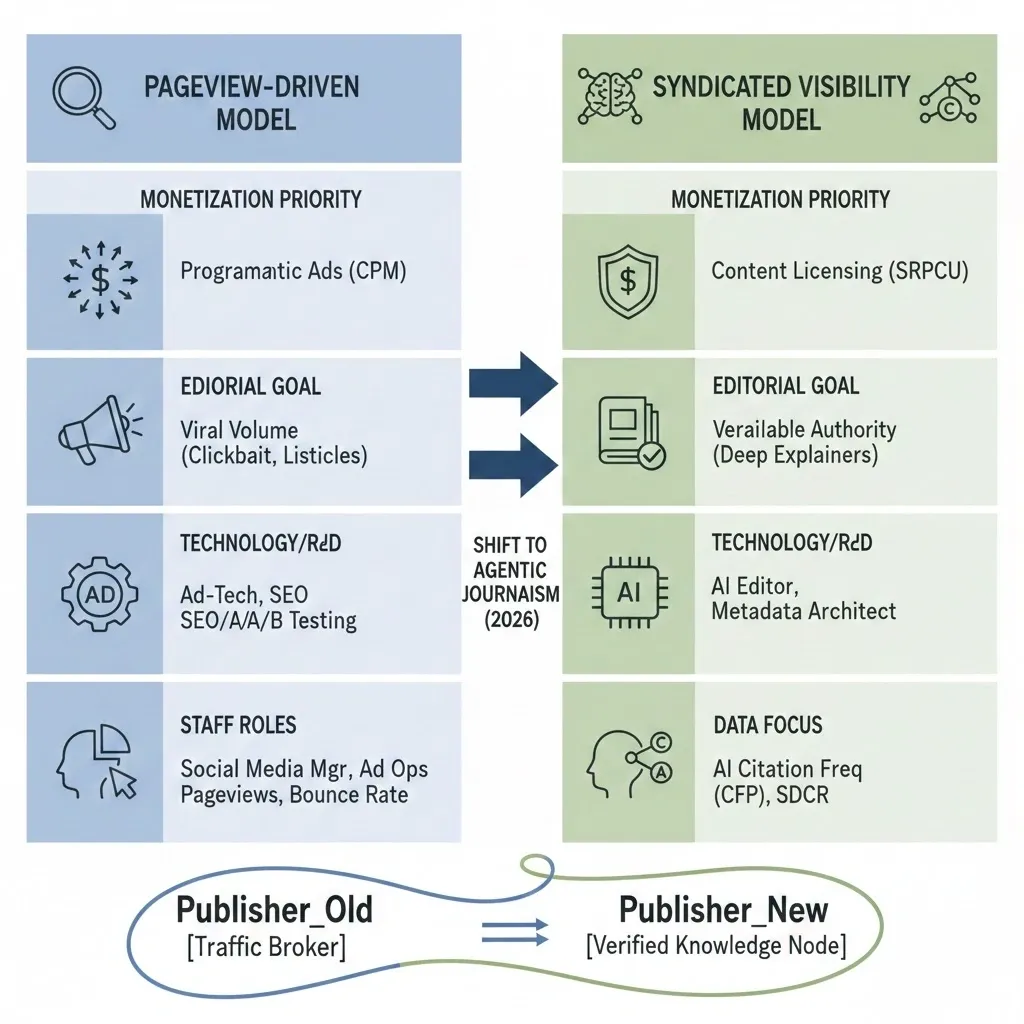
Why being quoted by machines, not clicked by humans, will decide the future of news Introduction: When the Click Stopped Being the Unit of Truth For nearly three decades, the economics of digital journalism rested on a deceptively simple assumption: if you could attract attention, you could monetise it. Pageviews became the proxy for relevance, clicks the proxy for value, and referral traffic the proxy for power. News organisations learned to live and die by dashboards that counted sessions, bounce rates, and organic search volume. The homepage was king. The article URL was the atomic unit of distribution. That world is now ending—not with a dramatic collapse, but with a quiet erosion. The defining shift of late 2025 is not that artificial intelligence can now summarise the news. That was inevitable. Nor is it that search engines are changing how results are presented. They always do. The real rupture is subtler and more consequential: Journalism is being consumed increasingly without being visited. Readers are no longer required to enter a publisher’s site to encounter its reporting. They meet journalism inside AI-generated answers—compressed, reassembled, contextualised, and presented as part of a larger synthetic response. The article still exists, but the user session does not. In this new environment, the primary question for a newsroom is no longer “How many people came to us?” but rather: “How often, how prominently, and how accurately were we quoted by the machines that now mediate knowledge?” This is what we mean by syndicated visibility—sometimes called quoted-by-AI visibility. It is the emerging metric of success in an ecosystem where visibility flows through intermediaries that do not hand over traffic in proportion to value extracted. The implications are profound. Journalism is returning, in a transformed guise, to a model that predates the web: syndication. But unlike wire services of the 20th century, this syndication is algorithmic, opaque, and global by default. And unlike the old world, where syndication was a supplement to direct readership, here it is fast becoming the main channel. This essay argues that syndicated visibility is not a buzzword or a temporary adaptation. It is the structural logic of news distribution in the AI era. Understanding it—measuring it, optimising for it, and governing it—will determine whether journalism remains a viable public institution or dissolves into an uncredited input layer for machine intelligence. I. The End of the Click-Centric World 1. The slow death of referral traffic Search once delivered readers to publishers in abundance. That bargain—content in exchange for visibility—was never entirely fair, but it was stable enough to build an industry around. SEO became a craft, then a science, then a pathology. Entire editorial strategies were shaped by keyword demand curves and Google’s shifting incentives. AI summaries have broken this equilibrium. By late 2025, multiple independent datasets—industry reports, academic studies, and browser-level behavioural analyses—converged on the same conclusion: when an AI-generated answer appears, users are significantly less likely to click through to source websites. In some categories, the decline is modest; in others, catastrophic. But the direction is unambiguous. More importantly, zero-click consumption has become normal behaviour. Users are no longer dissatisfied when they do not visit a publisher. They believe they have already “read the news” because an answer has been rendered complete at the interface level. This is not a failure of journalism. It is a triumph of interface design. 2. Why “better headlines” will not save you Many newsrooms initially responded with familiar instincts: optimise headlines, tighten summaries, improve metadata, hope to win back clicks. This misunderstands the nature of the shift. AI answers are not competing with articles in the way one headline competes with another. They are replacing the act of browsing itself. The user is no longer choosing between links; the system is choosing on their behalf what to incorporate, compress, and present. In that environment, marginal improvements in click-through rates are irrelevant. The competition has moved upstream—from user attention to machine selection. II. Defining Syndicated Visibility 1. What it is—and what it is not Syndicated visibility refers to a publisher’s success inside AI-mediated responses, not outside them. It captures three core dimensions: This is not traditional syndication. There is no explicit contract for each instance of reuse. There is no negotiated placement or guaranteed audience. And there is often no click. But functionally, it serves the same role: your journalism circulates beyond your owned surfaces, embedded in other products, generating value you do not fully control. 2. Why “quoted-by-AI” matters more than “ranked on Google” In the classic search era, ranking first meant visibility. In the AI era, being quotable matters more than being rankable. AI systems prefer sources that are: This subtly but decisively favours certain kinds of journalism: explanatory reporting, primary-source analysis, investigative work with clear evidentiary chains. It disfavors content optimised purely for novelty or outrage without grounding. This is not necessarily a moral victory—but it is a structural one. III. Why Syndicated Visibility Emerged in 2025 (Not Earlier) 1. The maturation of AI interfaces Earlier AI systems could generate text, but they were unreliable narrators. Publishers could plausibly dismiss them as toys, plagiarism engines, or hallucination factories. That dismissal is no longer credible. By late 2025, AI-generated answers have become: The shift crossed a threshold from experimentation to infrastructure. 2. The collapse of the “drive traffic, then monetise” loop The old model assumed a linear flow: Search → Article → Engagement → Revenue AI breaks this loop: Search → Answer → Satisfaction → Exit The article may be present, but the loop no longer passes through the publisher’s site. Once that loop breaks at scale, traffic ceases to be a reliable proxy for impact. Syndicated visibility fills that void. It is not a perfect replacement—but it is the only metric that corresponds to where journalism is actually being consumed. IV. The New KPI Stack in Newsrooms 1. From clicks to citations Forward-looking publishers are already shifting internal dashboards away from raw traffic metrics and toward indicators such as: This is not an abandonment of audience measurement. It is an acknowledgment that the location of audience contact has

Uncategorized

SAM AI Audio: When Sound Becomes the Operating System of Reality

AI Deepfake audio is not just another entry in the vector of synthetic media. It is a threshold technology. Text manipulates meaning. Images manipulate perception. Audio manipulates presence. And presence is the closest proxy we have to reality itself. 1. From Fake Content to Synthetic Worlds Most discussions frame deepfake audio narrowly: This is shallow analysis. Audio is not merely content. It is context. With controlled audio, you can generate: The brain does not ask “Is this real?” It asks “Is this coherent?” If coherence exists, experience follows. This is where SAM Audio enters. 2. What is SAM Audio? SAM Audio (Synthetic Acoustic Modeling) is not just voice synthesis. It is the procedural generation of auditory reality. It includes: When layered correctly, audio becomes a world engine. Visuals can lag. Audio cannot. Remove visuals from VR → presence remains. Remove audio → reality collapses. 3. Why Audio Dominates the Mind Neuroscience explains this cleanly. In short: Sound controls state. State controls perception. Perception constructs reality. This is not philosophy. This is systems biology. 4. From Signal Processing to Spiritual Insight Ancient traditions understood this without FFTs or neural nets. AUM (ॐ) is not a “word”. It is a state transition function. Sound precedes form. Modern physics echoes this: In this sense, SAM Audio is a technological mirror of ancient insight: Control vibration → influence experience → shape worlds. Hence the invocation: Aum Tat Sat Sound. Truth. Existence. 5. The Power and the Risk Here lies the uncomfortable truth. If humans gain full control over synthetic audio environments: A fake image can be doubted. A fake voice can command. This is why audio deepfakes are more dangerous than visual ones. They hijack authority, familiarity, and emotion simultaneously. SAM Audio is therefore a civilizational technology, not a media trick. 6. The Ethical Axis Every powerful layer demands restraint. Fire gave warmth and war. Electricity gave light and torture. Audio synthesis will give: The question is not can we build it? We already have. The question is: Who holds the tuning fork? 7. Conclusion: Audio as the Hidden God Layer We are entering an era where: In such a world, audio is no longer a sense. It is an interface. Control the interface, and you do not merely tell stories. You author realities. That is why SAM Audio sits quietly beneath the noise— and why it may become the most powerful technology of this decade. Aum Tat Sat. Search for:  Enterprise AI Strategic Framework artificial intelligence enterprise  ai transformation

Career in Enterprise AI

40 Hottest AI Roles that CETA and CABA Members fit

1. AI Prompt Engineer / LLM Interaction Designer Role Overview The Prompt Engineer / LLM Interaction Designer is responsible for engineering reliable, controllable, and task-effective interactions between humans, systems, and large language models. The role focuses on translating ambiguous user intent and business requirements into structured prompts, schemas, and interaction flows that yield predictable, evaluable outputs across contexts and workloads. This is not copywriting. It is applied interface engineering for probabilistic systems. Pre-requisite Qualification Experience Mandatory Skills Nice to Have Skills 2. LLM Application Engineer Role Overview The LLM Application Engineer builds production-grade applications where LLMs are embedded as functional components, not demos or chat toys. The role sits at the intersection of backend engineering, AI integration, and product logic—responsible for turning model capabilities into reliable, scalable, and testable software systems. This role exists because LLMs alone do nothing useful. Value is created only when they are orchestrated with APIs, data stores, business rules, and user workflows. Pre-requisite Qualification Experience Mandatory Skills Nice to Have Skills 3. AI Workflow Automation Engineer Role Overview The AI Workflow Automation Engineer designs and implements end-to-end automated workflows where LLMs, tools, and enterprise systems operate together with minimal human intervention. The role focuses on replacing brittle, rule-based automation with adaptive, AI-driven process execution that can handle ambiguity, exceptions, and evolving inputs. This is not RPA with prompts. It is AI-native orchestration across systems, data, and decisions. Pre-requisite Qualification Experience Mandatory Skills Nice to Have Skills 4. No-Code / Low-Code AI Automation Specialist Role Overview The No-Code / Low-Code AI Automation Specialist enables rapid deployment of AI-powered automations using visual, declarative, and configuration-driven platforms. The role focuses on time-to-value, allowing non-engineering teams to leverage LLMs and AI services safely within predefined guardrails. This role is not about bypassing engineering. It is about operationalizing AI at scale without writing full custom systems, under architectural and governance constraints.

Scroll to Top