What is QLI, what it runs, and why its model is unique and structurally different
1. What is QLI?
QLI (QAF Lab India) is not a conventional training institute. It is a capability-and-placement lab operated by QAF Lab India, designed to close a specific market failure:
Degrees certify exposure. Bootcamps teach tools. Employers demand proof of delivery.
QLI exists to bridge this gap by converting learners into verifiable, work-tested professionals through a controlled pipeline: diagnosis → instruction → execution → placement.
It positions itself closer to a talent transformation system than an education vendor.
2. Flagship Programs (QLI Core)
QLI’s curriculum architecture is anchored around two flagship certifications, each mapped to enterprise-grade roles.
● Certified Enterprise Transformation Analyst (CETA)
Focus: Enterprise transformation, AI strategy, operating models, and systems thinking. Outcome: Analysts who can reason across governance, IT, operations, finance, and risk—not just code or tools.
Typical role trajectories:
-
Enterprise / Business Transformation Analyst
-
AI Strategy & Operating Model Analyst
-
Digital Transformation Consultant
● Certified Algorithmic Bias Auditor (CABA)
Focus: Algorithmic risk, bias, governance, auditability, and regulatory alignment. Outcome: Professionals who can audit and govern AI systems under real-world constraints.
Typical role trajectories:
-
Algorithmic Bias Auditor
-
Responsible AI / Model Risk Analyst
-
AI Governance & Compliance Specialist
Key point: These programs are role-first, not syllabus-first. Content is derived backward from what industry can actually employ.
3. How QLI Places Candidates (Mechanism, not marketing)
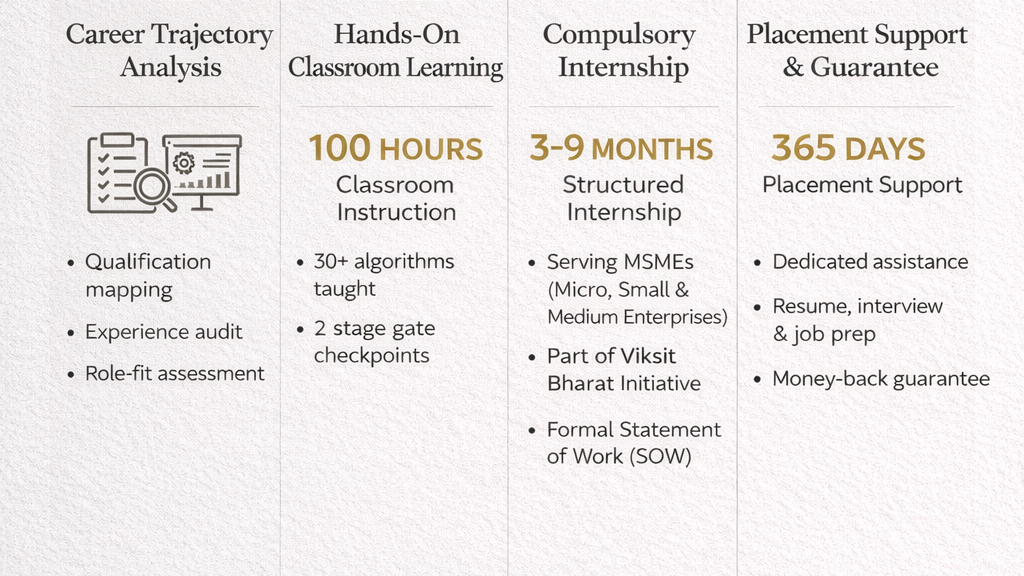
QLI does not promise placement by résumé circulation alone. Placement is treated as a systems problem, solved through four enforced stages:
Stage 1 — Career Trajectory Analysis
-
Qualification mapping
-
Experience audit
-
Role–fit assessment
Purpose: Eliminate mismatch early. This reduces downstream placement failure.
Stage 2 — Hands-On Classroom Learning
-
~100 hours of structured instruction
-
30+ algorithms / frameworks
-
Stage-gated evaluations
Purpose: Ensure baseline competence before real exposure.
Stage 3 — Compulsory Internship (3–9 months)
-
Real projects with MSMEs
-
Formal Statement of Work (SOW)
-
Delivery artifacts, not simulated case studies
Purpose: Convert learning into verifiable proof-of-work.
Stage 4 — 365-Day Placement Support
-
Dedicated placement assistance
-
Resume, interview, and job-readiness prep
-
Money-back guarantee (as per T&Cs)
Purpose: Placement treated as a process window, not a one-day event.
Structural insight: Employers hire QLI candidates because they come with auditable work outputs, not just certificates.
4. QLI Membership — What You Actually Get
QLI membership is the operating layer that makes the above system work.
Core Benefits
-
Access to flagship programs (CETA / CABA)
-
100+ hours of structured classroom learning
-
Mandatory industry internship pipeline
-
365 days of placement support
-
Flexible schedules (working professionals & students)
-
EMI / financing options
-
Money-back guarantee (conditions apply)
Strategic Benefit (often missed)
Membership is not transactional. It embeds the learner into:
-
An enterprise-aligned curriculum ecosystem
-
A mentor + evaluator network
-
A delivery-first credibility model
This is why QLI positions itself as a lab, not an academy.
5. Bottom Line (Unvarnished)
-
QLI does not sell education alone
-
It sells employability under constraints
-
Its advantage lies in enforced internships, SOW-based work, and long-horizon placement support
In a market flooded with certificates, QLI optimizes for the only signal that survives scrutiny: demonstrated, documented delivery.