The belief that AI will create more jobs than it destroys does not come from optimism alone. At its strongest, it comes from a particular economic reading of technological change: AI is not merely a tool that substitutes for human labour; it is a general-purpose technology that lowers the cost of cognition, expands the frontier of feasible work, creates new demand, and generates new coordination, verification, governance, and maintenance functions around itself.
But the claim is often overstated. AI may create more work than it destroys. Whether that work becomes stable, well-paid, geographically distributed, and socially useful jobs is a separate question. That distinction is essential.
The serious version of the claim is this:
AI will create jobs if cheaper cognitive execution expands demand faster than it displaces existing task labour, and if institutions convert that new demand into durable occupations.
That is the analytical core.
1. The first reason: AI lowers the cost of cognition
Every major productivity technology reduces the cost of some scarce input.
The steam engine reduced the cost of mechanical power. Electricity reduced the cost of distributed energy. Computers reduced the cost of calculation and information processing. The internet reduced the cost of communication and distribution. AI reduces the cost of cognition-like tasks: drafting, summarising, classifying, coding, translating, searching, designing, recommending, comparing, detecting, planning, and simulating.
This matters because many activities were not previously impossible; they were simply too expensive, too slow, or too skill-dependent.
A small business may have wanted analytics but could not afford an analyst. A teacher may have wanted personalised learning material but did not have the time. A lawyer may have wanted deeper precedent scanning but could not justify the hours. A journalist may have wanted to examine thousands of documents but lacked manpower. A product team may have wanted to test twenty prototype ideas but had capacity for three.
AI changes the economics of these “latent tasks.”
When the cost of a useful input falls, three things can happen.
First, firms produce the same output with fewer workers. That is the displacement story.
Second, firms produce more output with the same workers. That is the productivity story.
Third, entirely new products, services, workflows, and business models appear because the input has become cheap enough to use everywhere. That is the job-creation story.
The job-creation argument depends mainly on the third effect.
This is why AI is compared to previous general-purpose technologies. The most important economic effect of a general-purpose technology is not the first automation use case. It is the second-order reorganisation of industries around the newly cheap input.
Electricity did not merely replace steam engines. It redesigned factories. Computers did not merely replace clerks. They enabled software, digital finance, logistics optimisation, e-commerce, cloud computing, and platform businesses. AI may not merely replace writers, analysts, or coders. It may redesign how decisions, services, interfaces, products, audits, education, care, and enterprise workflows are produced.
That is why the claim is plausible.
But plausibility is not certainty.
2. The second reason: demand can expand when cost collapses
The most common economic logic behind the claim is the rebound effect, often discussed through Jevons Paradox. If a technology makes a resource more efficient, total consumption of that resource may rise because it becomes cheaper and more widely usable.
Applied to AI, the argument is simple:
If the cost of intelligence-like work falls, society may consume far more intelligence-like work.
That means more analysis, more software, more documentation, more monitoring, more customer interaction, more tutoring, more design, more experimentation, more compliance checks, more simulations, more internal tools, and more personalised services.
The classic modern example is ATMs and bank tellers. ATMs reduced the number of tellers required per branch, but they also lowered the cost of operating branches. Banks opened more branches, and teller work shifted toward relationship management and sales rather than only cash handling. James Bessen’s account notes that the average number of tellers needed per urban branch fell from 20 to 13 between 1988 and 2004, while urban bank branches increased by 43%, so teller jobs did not disappear in the simple way many expected. (IMF)
The lesson is not that automation always saves jobs. The lesson is more precise:
If automation reduces unit cost and demand is elastic, total employment can rise even when labour per unit falls.
This is the heart of the AI job-creation argument.
For AI, the elastic-demand sectors are likely to include software development, content production, education support, marketing, cybersecurity, analytics, internal automation, compliance monitoring, translation, simulation, product experimentation, and small-business services. Many organisations currently under-consume these services because they are expensive. If AI reduces cost, demand may expand.
For example, a company that previously built two dashboards may now build twenty decision-support systems. A teacher who previously prepared one standard worksheet may create ten personalised learning paths. A compliance team that sampled 2% of transactions may monitor 100% of cases with AI-assisted triage. A startup that previously needed five engineers for a prototype may launch with two engineers and one AI-augmented operator.
In each case, AI does not merely remove labour. It changes the scale of feasible activity.
However, the elasticity condition is critical. If demand does not expand, AI becomes a labour-saving tool rather than a job-creating tool.
A company does not need ten statutory audits because audits become cheaper. A bank does not necessarily need ten times more regulatory filings. A law department may not need ten times more contracts. A hospital may not need ten times more discharge summaries if clinical throughput is constrained elsewhere.
So the correct model is not:
AI lowers cost → demand rises → jobs increase.
The correct model is:
AI lowers cost → demand rises where demand is elastic → new roles emerge where institutions convert that demand into occupations.
That conditional structure is often missing in casual claims.
3. The third reason: jobs are task bundles, not single tasks
Most public debate fails because it treats jobs as if they are single activities.
But a job is a bundle of tasks, responsibilities, relationships, judgement calls, contextual knowledge, tacit routines, institutional authority, and accountability. AI may automate some tasks inside a job without eliminating the job itself.
The International Labour Organization has repeatedly made this distinction in its work on generative AI. Its 2025 update describes exposure at the task and occupation level, with clerical occupations remaining the most exposed, while also noting that some professional and technical occupations are becoming more exposed as AI capabilities expand. (International Labour Organization) The earlier ILO framing also emphasised that generative AI is more likely to augment and transform jobs than simply destroy entire occupations. (International Labour Organization)
This distinction matters because exposure is not the same as displacement.
If 40% of a job’s tasks can be automated, the result may be job loss, job redesign, higher output, shorter hours, lower wages, higher wages, or new responsibilities. The outcome depends on bargaining power, market demand, organisational design, regulation, and skill adaptation.
A lawyer may use AI for document review but still handle negotiation, litigation strategy, client trust, liability, and courtroom judgement. A journalist may use AI for transcription and archive search but still need source evaluation, editorial judgement, field reporting, and narrative responsibility. A software engineer may use AI for boilerplate code but still need architecture, debugging, security, deployment, and product reasoning. A teacher may use AI for lesson generation but still need classroom management, emotional intelligence, assessment, and social authority.
This is why many economists expect transformation before elimination.
Goldman Sachs estimated in 2023 that generative AI could expose the equivalent of 300 million full-time jobs globally to automation, but the same analysis argued that generative AI could raise global GDP by 7% and lift productivity growth by 1.5 percentage points over a decade. (Goldman Sachs) Exposure here means task exposure, not automatic unemployment.
The IMF similarly estimated that almost 40% of global employment is exposed to AI, rising to about 60% in advanced economies, but it divided exposed jobs into those likely to benefit from complementarity and those where AI may reduce labour demand. (IMF) This is a much more disciplined reading than “AI will replace everyone.”
The key point is:
AI may reduce human labour per task while increasing the number, complexity, and scope of tasks performed.
If that happens, jobs evolve rather than vanish.
4. The fourth reason: technology historically creates “new work”
One reason economists resist simple automation panic is that much of today’s employment exists in roles that were not present in previous eras.
David Autor and co-authors estimate that roughly 60% of U.S. employment in 2018 was in job titles that did not exist in 1940; among professional occupations, the share was about 74%. (MIT Economics) This does not prove AI will repeat the same pattern, but it shows that technological economies do not merely reallocate a fixed stock of jobs. They generate new occupational categories.
Modern economies employ cloud architects, app developers, UX researchers, cybersecurity analysts, digital marketers, data engineers, drone operators, platform trust-and-safety analysts, SEO specialists, machine-learning engineers, creator-economy managers, and many other roles that were not meaningful categories in earlier industrial economies.
AI could similarly create new work around:
AI workflow design model evaluation AI safety testing prompt and context engineering agent orchestration AI governance synthetic data management human-AI interface design AI-assisted education model risk management AI procurement AI audit AI compliance AI security AI incident response data provenance simulation design personalised service design AI operations agent monitoring model routing and cost optimisation
Some of these will become full occupations. Others will become skill layers inside existing occupations.
This is already visible in enterprise language. Firms are not only asking whether employees can use AI tools. They are asking who can design workflows, validate outputs, manage risk, ensure compliance, integrate AI into systems, monitor performance, handle failures, and maintain accountability.
That is the “control surface” argument.
The more AI enters operations, the more control surfaces multiply.
5. The fifth reason: complex automation creates coordination work
A naïve automation model assumes that once machines perform tasks, humans disappear.
In real organisations, the opposite often happens. Automation increases system complexity. Complexity creates coordination, monitoring, exception-handling, governance, and accountability work.
This is especially true for AI because AI systems are probabilistic, context-sensitive, opaque, data-dependent, and vulnerable to silent failure.
A spreadsheet formula usually fails deterministically. A traditional software system often fails in traceable ways. An AI system may produce plausible nonsense, biased outputs, fabricated citations, insecure code, policy-violating recommendations, or inconsistent results across similar cases.
That means AI creates verification work.
The scarce labour may shift from “doing the first draft” to “knowing whether the first draft is valid.”
In enterprise settings, this creates demand for people who can:
define acceptable use cases evaluate model performance monitor drift test outputs across segments detect bias manage data quality red-team prompts secure tool access document decisions design approval workflows audit model behaviour manage vendors translate regulation into controls investigate AI incidents decide when humans must intervene
This is why AI governance is not a decorative layer. It is operational infrastructure.
The OECD’s 2023 Employment Outlook noted that AI use at work can be associated with positive outcomes such as job satisfaction, health, and wages, but also risks around privacy, work intensity, and bias. (OECD) Those risks are not abstract. Each risk creates organisational work if institutions are serious about control.
As AI systems scale, the economy may shift from a production bottleneck to a verification bottleneck.
The old problem was: “Can we produce enough analysis, text, code, support, and decisions?”
The new problem becomes: “Can we trust, verify, govern, and legally defend what has been produced?”
That is a job-creation mechanism, but a demanding one. It does not create easy jobs. It creates jobs requiring domain knowledge, judgment, audit discipline, and institutional authority.
6. The sixth reason: AI can increase productivity, income, and downstream demand
Another reason AI is expected to create jobs is the macroeconomic productivity channel.
If AI raises productivity, it can increase output, profits, wages in complementary roles, and aggregate income. Higher income then increases demand for goods and services, including services that are not directly automated.
This is how technological progress often affects employment. It may reduce labour demand in one activity while increasing demand elsewhere through income effects.
Goldman Sachs projected that generative AI could raise global GDP by about 7% and lift productivity growth by 1.5 percentage points over a ten-year period if broadly adopted. (Goldman Sachs) McKinsey estimated that generative AI could enable labour productivity growth of 0.1 to 0.6 percentage points annually through 2040 depending on adoption speed and worker redeployment. (McKinsey & Company)
These projections are uncertain, but they explain why many analysts believe AI can be employment-positive over time. Productivity growth expands economic capacity. If demand exists and institutions distribute income broadly enough, new employment can emerge.
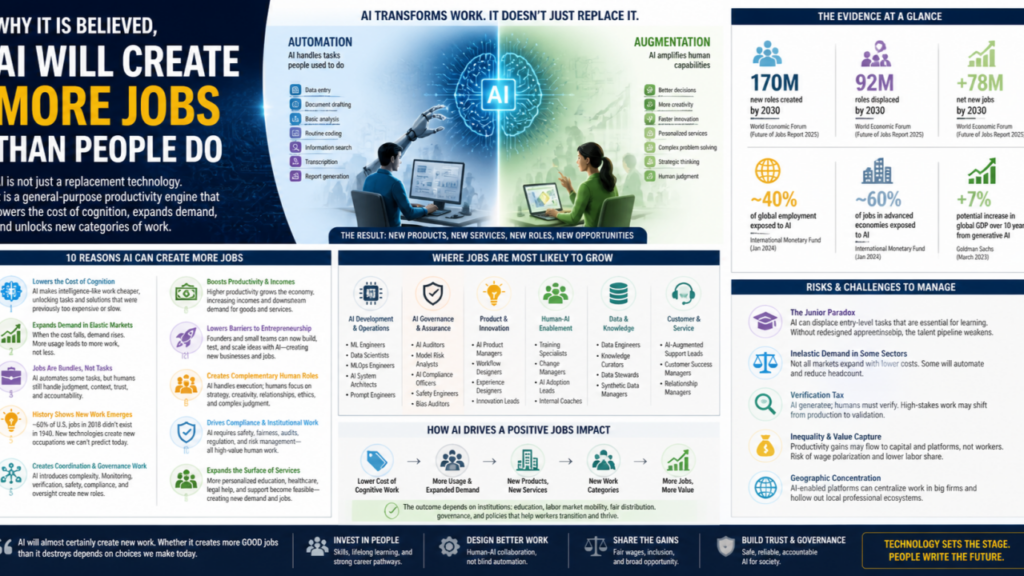
The World Economic Forum’s Future of Jobs Report 2025 projected that global labour-market transformation would create 170 million new roles and displace 92 million roles by 2030, resulting in a net increase of 78 million jobs. (World Economic Forum) The WEF report is not an AI-only forecast; it includes technology, demographic change, green transition, geoeconomic fragmentation, and economic pressures. But AI and information-processing technologies are central to the transformation narrative. (World Economic Forum)
This is important: even favourable forecasts do not say AI creates jobs without pain. They describe churn. A net gain of 78 million roles still includes 92 million displaced roles. That is not a smooth transition. It is a large reallocation problem.
The optimistic thesis therefore depends on labour-market mobility, training systems, wage growth, institutional adaptation, and demand expansion. Without those, productivity gains can coexist with human insecurity.
7. The seventh reason: AI lowers the cost of entrepreneurship
AI may create jobs not only inside existing firms but also through new firm formation.
Entrepreneurship has always been constrained by execution cost. A founder needed designers, developers, analysts, marketers, support staff, legal help, documentation, research capacity, and operational tooling. AI reduces the minimum viable team size.
That does not mean every person becomes an entrepreneur. But it does mean more people can test ideas, build prototypes, create niche products, serve micro-markets, and operate specialised services.
This can create new work in two ways.
First, AI-native startups may hire workers for new categories of activity: product operations, AI supervision, domain-specific workflow design, data partnerships, customer implementation, compliance, and support.
Second, small firms may become more competitive because they can access capabilities previously restricted to large firms.
A small accounting practice may offer AI-assisted advisory dashboards. A local training company may create personalised learning products. A small legal firm may handle more document-intensive cases. A journalist may build independent research products. A consultant may automate delivery infrastructure and focus on interpretation.
This is the democratization side of the argument.
But there is a counter-risk: AI may also favour large firms with superior data, compute, distribution, brand trust, and capital. The same technology that empowers small firms can allow dominant firms to scale into local markets.
So AI may increase entrepreneurship while also increasing concentration. Both can be true.
8. The eighth reason: AI creates complementary human roles
AI is powerful at generation, pattern recognition, and routine cognitive support. It is weaker at responsibility, legitimacy, moral judgement, relationship trust, embodied care, political negotiation, institutional accountability, and domain-grounded wisdom.
That creates complementary human roles.
The more AI generates, the more humans may be needed for:
judgement taste prioritisation ethical interpretation client trust contextual decision-making stakeholder negotiation liability-bearing approval exception handling cross-functional translation human care pedagogy leadership institutional design
In other words, AI may push human work away from execution and toward orchestration.
This is not automatically good. Orchestration roles are usually fewer, more demanding, and less accessible than execution roles. But they are real.
This is why “AI supervisor” is a plausible future category, but also why the junior paradox matters. Supervisors require expertise. Expertise requires exposure to the very tasks AI may automate.
The job-creation argument is strongest where AI complements human judgement rather than replacing it. The IMF’s analysis is useful here because it explicitly distinguishes exposure from complementarity. In advanced economies, about 60% of jobs may be exposed to AI, but roughly half of those exposed jobs may benefit from AI integration while the other half may face reduced labour demand. (IMF)
That means AI is not a uniform shock. It is a sorting mechanism.
Workers whose tasks are complemented by AI may become more productive and valuable. Workers whose tasks are substituted may face wage pressure, reduced hiring, or displacement.
This is why skill distribution matters.
9. The ninth reason: AI creates new compliance and institutional obligations
As AI becomes embedded in regulated domains, it creates new obligations.
Organisations will need to prove that AI systems are safe, fair, explainable where required, auditable, privacy-preserving, secure, and aligned with internal policies. This is not optional in finance, healthcare, hiring, insurance, education, public services, and critical infrastructure.
Regulation turns vague concern into operational work.
Even outside formal law, firms face reputational, contractual, and liability pressures. A company using AI in customer decisions must explain failures. A hospital using AI for triage must manage safety. A bank using AI in credit workflows must monitor discrimination, stability, and model risk. A media company using AI-generated content must verify facts. A software firm using AI-generated code must test security.
This creates roles around AI assurance.
The job categories may include AI compliance officer, model risk analyst, AI audit specialist, AI safety engineer, data provenance manager, algorithmic bias auditor, AI incident investigator, human-in-the-loop workflow designer, and enterprise AI governance lead.
These roles are unlikely to employ everyone displaced from routine work. But they are a real source of new labour demand.
The more AI matters, the more assurance matters.
10. The tenth reason: AI increases the feasible surface area of services
Human needs are not fixed. Many services are under-supplied because human attention is expensive.
Education is under-personalised. Healthcare is under-monitored. Mental-health support is under-available. Legal support is unaffordable for many. Small-business consulting is scarce. Government service delivery is slow. Scientific literature is too large for humans to process manually. Enterprise knowledge is poorly searched and poorly reused.
AI can expand service surfaces by making first-line support cheaper.
This does not mean AI should replace professionals in high-stakes areas. But it can create hybrid delivery models: AI handles triage, preparation, explanation, document assembly, scheduling, translation, simulation, and monitoring; humans handle judgement, escalation, care, responsibility, and complex cases.
If designed well, this can create more employment around expanded access.
For example, AI tutoring may not eliminate teachers if it increases demand for learning support, curriculum design, assessment, mentoring, and special-needs interventions. AI medical support may not eliminate clinicians if it increases early detection, follow-up, monitoring, and care coordination. AI legal tools may not eliminate lawyers if they expand access to legal preparation and increase demand for review, negotiation, and representation.
The economic question is whether AI substitutes for professional labour or expands the market to underserved users.
Again, elasticity matters.
11. The case against the claim: the junior paradox
The strongest objection is not that AI will destroy all jobs. That is too crude.
The strongest objection is that AI may destroy the apprenticeship layer.
AI is especially good at tasks historically assigned to juniors: drafting, summarising, data cleaning, routine research, simple coding, documentation, slide creation, test writing, document review, and first-pass analysis.
But these tasks were not merely low-value outputs. They were training grounds.
Juniors learned by doing imperfect work, receiving correction, observing standards, building pattern recognition, and gradually absorbing domain judgement. If AI takes over those tasks, firms may reduce junior hiring. Then, after several years, they may discover a shortage of mid-level and senior talent.
This creates a hollowed-out labour hierarchy.
The contradiction is severe:
Firms want senior judgement while automating the work through which senior judgement is formed.
This risk is particularly serious in software engineering, law, consulting, journalism, audit, finance, design, architecture, and analytics.
It also weakens the AI job-creation argument. Many new AI-era roles require judgement. But if AI erodes the path into judgement, the labour market may create demand for roles that too few workers are trained to fill.
This is why enterprise adoption should not blindly automate junior tasks. Firms need redesigned apprenticeship systems where juniors use AI but still learn reasoning, verification, domain standards, and error detection.
The future entry-level role cannot be “do what AI cannot do,” because that standard may be too high for beginners. The future entry-level role must be deliberately educational: compare AI output, detect mistakes, explain reasoning, validate sources, test assumptions, and gradually take responsibility.
Without this, AI may create a senior-demand boom and a junior-opportunity collapse at the same time.
12. The second case against the claim: inelastic demand
Jevons Paradox is not universal.
Demand expands when cheaper supply reveals latent demand. But many markets are bounded by regulation, budgets, trust, time, liability, or institutional need.
If AI makes annual audits cheaper, the firm may not buy more audits. It may simply spend less.
If AI makes legal drafting cheaper, some clients may buy more legal services, but others may keep the same volume and reduce outside counsel spend.
If AI makes customer support cheaper, firms may expand support coverage, but they may also reduce human headcount and tolerate lower service quality.
If AI makes coding cheaper, software demand may expand dramatically in some sectors, but in mature firms it may also reduce the need for large teams maintaining routine systems.
So the displacement effect dominates where demand is inelastic.
This means the AI employment effect will vary by sector.
Elastic sectors may grow. Inelastic sectors may consolidate. Trust-constrained sectors may hybridise. Regulated sectors may shift labour from production to verification. Platform sectors may concentrate returns.
The claim “AI creates more jobs” is therefore too broad. A better claim is:
AI creates jobs in markets where lower cognitive cost expands demand more than it reduces labour per unit.
That is more precise.
13. The third case against the claim: verification tax
AI does not eliminate work; it often shifts work from production to verification.
In low-stakes contexts, the productivity gain is obvious. Drafting a routine email in 20 seconds is useful. Summarising a meeting quickly is useful. Generating boilerplate code can help.
In high-stakes contexts, the equation changes.
If AI writes a legal memo in five minutes but a lawyer needs two hours to verify every citation, assumption, and risk, the productivity gain is smaller. If AI writes code quickly but engineers spend significant time debugging security flaws, the gain shrinks. If AI generates market analysis but analysts must validate every source and number, the work has not disappeared; it has moved.
This is the cost of veracity.
AI increases the quantity of plausible output. Plausibility is not truth. The more plausible output floods an organisation, the more scarce verification becomes.
This creates jobs, but it also undermines naive productivity claims.
The future may not be “AI does the work and humans relax.”
It may be:
AI generates at scale, and humans struggle to verify at scale.
That is why evaluation, audit, testing, and governance will become core labour categories.
14. The fourth case against the claim: capital may capture the value
Even if AI creates more work, workers may not capture the gains.
General-purpose technologies often change the distribution of income. If the key assets are models, data, compute, platforms, and distribution, returns may flow to capital owners rather than labour.
A worker may become more productive with AI, but the wage gain depends on bargaining power. If many workers can use the same tools, their individual scarcity may decline. If the platform captures the productivity surplus, labour share can fall.
The OECD notes that workers with AI skills are a small but rapidly growing share of employment and earn relatively high wages. (OECD) But wage premiums can coexist with broader polarisation: a small group of AI-complemented workers gains, while routine cognitive workers face pressure.
The IMF’s 2026 staff discussion note on new job creation in the AI age found that demand for new skills, especially IT and AI skills, is reshaping labour markets, with about one in ten vacancies in advanced economies demanding at least one new skill, but also warned that these skills can deepen polarization by mostly benefiting certain workers. (IMF)
So the right metric is not job count alone.
We need to ask:
Are wages rising with productivity? Is labour share stable? Are new jobs accessible? Are entry-level roles growing? Are career ladders intact? Are returns concentrated in a few firms? Are workers gaining bargaining power or merely supervising systems owned by others?
AI may create jobs and still worsen inequality.
15. The fifth case against the claim: geographical concentration
AI reduces the friction of distance.
A high-quality AI-enabled firm in a major city can serve clients across regions. A platform can scale expertise that was previously local. A top lawyer, tutor, designer, accountant, consultant, or software firm can use AI to handle more clients with fewer people.
This can hollow out local professional ecosystems.
The total volume of work may increase globally, but opportunity may concentrate among trusted brands, capital-rich firms, and platform intermediaries.
A local accountant may not lose work to AI directly. They may lose work to a national AI-enabled accounting platform. A local tutor may not lose work to an AI chatbot directly. They may lose work to a scaled education platform with AI personalisation and celebrity instructors. A small law firm may not lose work to a model. It may lose work to a larger firm that uses AI to serve mid-market clients at lower cost.
This is the winner-take-most geography of AI.
So again, the job-creation claim is incomplete. More total work does not guarantee broad local employment.
16. What the evidence actually says
The best available evidence does not support either extreme.
It does not support “AI will create effortless abundance for workers.” It also does not support “AI will make human labour obsolete.”
The evidence points to task transformation, uneven exposure, possible productivity gains, occupational churn, and distributional risk.
The WEF projects net job growth by 2030, but with large displacement: 170 million created, 92 million displaced, 78 million net new roles. (World Economic Forum)
The ILO finds that generative AI exposure is strongest in clerical occupations, while exposure is expanding into some professional and technical occupations. (International Labour Organization)
The IMF estimates nearly 40% of global employment is exposed to AI, about 60% in advanced economies, with roughly half of exposed advanced-economy jobs potentially benefiting from AI complementarity and the other half at risk of reduced labour demand. (IMF)
McKinsey estimates that by 2030, activities accounting for up to 30% of hours currently worked across the U.S. economy could be automated, with generative AI more likely to enhance STEM, creative, business, and legal work than eliminate those jobs outright, while office support, customer service, and food service face stronger decline pressures. (McKinsey & Company)
Goldman Sachs estimates large exposure but also large productivity upside, including a potential 7% increase in global GDP over a decade. (Goldman Sachs)
The disciplined interpretation is:
AI is not a pure unemployment machine. It is a labour-reallocation machine.
The quality of the outcome depends on whether reallocation is fast, fair, and institutionally supported.
17. Why people believe the net effect may be positive
Putting the argument together, people believe AI may create more jobs than it destroys for seven main reasons.
First, AI lowers the cost of cognition, and cheaper cognition expands the number of economically viable activities.
Second, demand for some AI-enabled services is elastic; lower cost can generate far more usage.
Third, jobs are bundles of tasks, so task automation often leads to job redesign rather than full elimination.
Fourth, historical general-purpose technologies created large categories of new work that were hard to predict in advance.
Fifth, AI creates new coordination, governance, verification, and accountability work around itself.
Sixth, productivity gains can raise income and downstream demand.
Seventh, AI lowers the cost of entrepreneurship and enables small teams to create products and services previously requiring larger organisations.
That is the optimistic logic.
But every part has a condition.
Cognition must become useful, not just cheap. Demand must expand, not saturate. Institutions must redesign work, not only cut labour. Education must preserve apprenticeship. Workers must capture some productivity gains. Governance must prevent failure and abuse. Local economies must not be fully hollowed out by platforms.
Without these conditions, AI may create work but degrade jobs.
18. The final answer
It is believed that AI will create more jobs than it destroys because AI reduces the cost of cognitive production, expands demand in elastic markets, transforms rather than eliminates many occupations, creates new forms of coordination and verification work, increases productivity, and enables new businesses and services.
But the belief is only defensible in a qualified form.
The crude version is:
AI will create more jobs than people lose.
The rigorous version is:
AI can create more economically useful work than it destroys if lower cognitive cost expands demand, if new work categories emerge fast enough, if workers are retrained into complementary roles, and if institutions preserve apprenticeship, wages, and accountability.
The danger is that AI may create more output without creating better livelihoods.
It may create more tasks but fewer careers. More productivity but lower labour share. More software but fewer junior developers. More content but less editorial trust. More analysis but higher verification burden. More global services but weaker local professional classes. More AI supervisors but fewer pathways to become one.
So the correct conclusion is neither optimism nor panic.
AI will almost certainly create new work. It may create many new jobs. But whether it creates more good jobs than it destroys depends less on the technology itself and more on labour-market design, institutional discipline, education systems, governance, and value distribution.
The future of work will not be decided by model capability alone.
It will be decided by whether societies can convert AI-generated productivity into human capability, durable careers, and fair economic participation.