There is a growing ritual in enterprise AI teams. A new initiative begins—usually framed as “RAG,” “semantic search,” or “agentic workflows”—and within weeks the conversation collapses into a familiar question:
Which vector database should we choose?
Pinecone or Qdrant. Milvus or Weaviate. Managed or self-hosted. Benchmarks are pulled. Latency numbers are compared. Architecture diagrams get redrawn.
It feels like a meaningful decision.
It is not.
In most cases, the decision has already been made—quietly, structurally, and upstream—long before the team starts comparing vendors. What looks like a tooling choice is actually a consequence of something deeper: where your data lives, how your systems are governed, and what failure you can tolerate.
The mistake is not choosing the wrong vector database. The mistake is believing that this is the layer where the real decision sits.
The Category Error That Keeps Repeating
The modern data stack is undergoing a shift from symbolic retrieval to semantic retrieval. That much is clear. What is less clear—and routinely misunderstood—is how this shift integrates with existing systems.
The common narrative suggests a clean replacement:
-
Traditional databases store structured data
-
Vector databases store embeddings
-
Therefore, vector databases are the future
This framing is wrong.
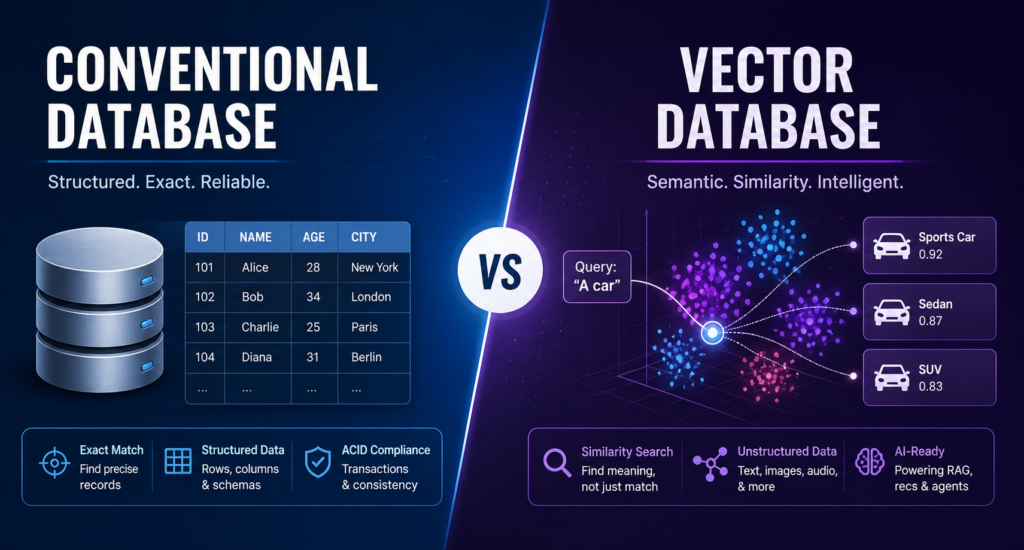
Vector systems are not replacements. They are retrieval mechanisms. They operate in a different space—geometric rather than symbolic—and they solve a different problem: finding meaning, not matching conditions.
A relational database answers:
“Find all records where X = Y.”
A vector system answers:
“Find the closest representations to this idea.”
These are not competing abstractions. They are orthogonal.
Yet the market continues to present them as alternatives, and teams continue to evaluate them as if they are substitutable. That is the first failure.
What Actually Differentiates Systems
When you strip away branding and positioning, every system in this space resolves into a small set of architectural choices:
-
Where is the data stored?
-
How is similarity computed?
-
What is the latency envelope?
-
How are updates handled?
-
What operational burden does the system introduce?
Everything else—APIs, SDKs, integrations—is surface area.
The real differences emerge in how systems answer these questions.
-
A relational database with vector support will store embeddings alongside structured data, but its indexing and update model is constrained by transactional workloads.
-
A purpose-built vector system will optimize for approximate nearest neighbor search, often at the cost of operational simplicity.
-
A lakehouse system will treat embeddings as another column in a massive analytical store, optimizing for scale and governance rather than latency.
These are not incremental differences. They define the behavior of the system under stress.
The Three Equilibria That Are Actually Emerging
If you observe production deployments rather than vendor narratives, a pattern appears. The ecosystem is not converging to a single dominant architecture. It is stabilizing around three distinct equilibria.
1. The Integrated OLTP Stack
This is the default path.
A team already runs PostgreSQL, MongoDB, or Cassandra. Vector capability is added—via extensions, plugins, or native features. The system now supports embedding storage and similarity queries alongside existing workloads.
The appeal is obvious:
-
No new infrastructure
-
Familiar operational model
-
Strong consistency guarantees
For many use cases, this is sufficient. Especially when the dataset is modest and the latency requirements are not extreme.
But the failure mode is predictable.
As the number of vectors grows and update frequency increases, the indexing structures—often graph-based (such as HNSW)—begin to degrade. Maintaining recall requires periodic re-indexing. Re-indexing consumes resources. Those resources compete with transactional workloads.
The system enters a tension:
-
Serve queries fast
-
Maintain index quality
-
Preserve transactional performance
It cannot optimize all three simultaneously.
This is where most teams discover that their “simple” solution has a ceiling.
2. The Specialized Retrieval Stack
This is the performance path.
Purpose-built systems—such as those designed around approximate nearest neighbor algorithms—optimize aggressively for retrieval:
-
High recall under tight latency constraints
-
Advanced filtering and hybrid search
-
Scalable indexing across large datasets
These systems treat vector search as a first-class problem, not an add-on.
The benefits are real:
-
Predictable performance at scale
-
Flexible retrieval strategies
-
Better control over indexing behavior
But they introduce a different class of problems.
The most obvious is data duplication.
Your source data lives in one system. Your embeddings—and often copies of metadata—live in another. Keeping them synchronized becomes a continuous process. Failures in this pipeline introduce inconsistencies that are difficult to detect.
The second problem is operational:
-
New infrastructure
-
New scaling concerns
-
New failure modes
The system is more powerful, but also more complex.
3. The Lakehouse / Analytical Stack
This is the governance path.
In many enterprises, data already resides in analytical platforms—data warehouses or lakehouses. These systems have begun to incorporate vector capabilities directly.
The logic is not performance. It is control.
-
Data stays where it already lives
-
Access controls remain consistent
-
Lineage and auditability are preserved
This eliminates one of the most painful aspects of the specialized stack: duplication and synchronization.
It also leverages data gravity—moving computation to data, rather than data to computation.
But the trade-off is clear.
These systems are not designed for low-latency retrieval. They excel at batch processing, large-scale analysis, and governed access—not real-time interaction.
For use cases like offline retrieval, analytics-driven RAG, or large-scale document processing, this model is effective.
For interactive systems—especially those requiring sub-100ms responses—it is not.
Why Most “Vector DB Evaluations” Miss the Point
The industry’s current obsession with comparing vector databases assumes that the decision sits at that layer.
It does not.
The choice is constrained by three upstream factors:
1. Data Location
If your data already resides in a lakehouse, the cost of extracting, transforming, and duplicating it into a separate system is not trivial.
If your application is tightly coupled to a relational database, introducing a second system changes the architecture more than the retrieval mechanism itself.
The question is not:
“Which vector database is best?”
It is:
“Where can I afford to move or duplicate data?”
2. Latency Requirements
Different use cases impose different constraints.
-
Offline analysis tolerates seconds or minutes
-
Interactive applications demand milliseconds
-
Agentic systems often require tight loops under strict latency budgets
Choosing a system without anchoring on latency leads to predictable failure.
3. Governance and Risk
Embedding pipelines introduce new risks:
-
Drift in embeddings over time
-
Inconsistent indexing states
-
Difficulty auditing retrieval decisions
Systems that integrate with existing governance frameworks reduce these risks. Systems that operate independently introduce new ones.
The trade-off is not technical alone. It is organizational.
The Hidden Cost of Getting It Wrong
The consequences of a poor decision are rarely immediate.
A system works. It passes initial tests. It handles early traffic.
The problems emerge later:
-
Recall degrades subtly as data grows
-
Latency spikes under load
-
Synchronization pipelines fail silently
-
Debugging becomes non-trivial
These are not catastrophic failures. They are slow erosions.
And because the system was “working,” the root cause is often misattributed.
What a Correct Decision Looks Like
A robust decision does not begin with vendor comparison. It begins with constraints.
A practical approach:
-
Identify where your data already lives
-
Define latency requirements explicitly
-
Understand update patterns
-
Assess tolerance for operational complexity
-
Plan for failure modes
Only after these are clear does vendor selection become meaningful.
A More Useful Mental Model
Instead of thinking in terms of products, think in terms of retrieval architectures.
-
Embedded retrieval within existing systems
-
Dedicated retrieval layers optimized for performance
-
Analytical retrieval integrated into data platforms
Each has a place.
The goal is not to find the “best” system. It is to align the system with the constraints of your environment.
Where the Industry Is Actually Heading
Vector capability is not becoming a standalone category. It is becoming a feature of every data system.
Relational databases now support embeddings. Search engines integrate vector ranking. Lakehouses offer similarity queries. Even edge systems incorporate lightweight vector stores.
This is not fragmentation. It is absorption.
The differentiation is shifting:
-
From “does it support vectors?”
-
To “how well does it support retrieval under constraints?”
And that question cannot be answered by taxonomy alone.
The Boundary That Matters
At this point, classification reaches its limit.
Understanding the landscape is necessary, but not sufficient. Beyond this, decisions depend on measurable properties:
-
Recall under different workloads
-
Latency distributions, not averages
-
Cost per query at scale
-
Behavior under updates
-
Failure containment and observability
Without this data, further discussion is speculative.
Vector Data Systems Landscape (2026)
I. Purpose-Built Vector Databases (ANN-first)
-
Pinecone — Managed serverless vector DB; the reference ANN-as-a-service product. https://www.pinecone.io
-
Milvus — Open-source distributed vector DB; the leading self-hosted choice for billion-scale workloads. https://milvus.io
-
Qdrant — Rust-based open-source engine; composable dense/sparse/metadata retrieval primitives. https://qdrant.tech
-
Weaviate — AI-native open-source vector DB; strong on multimodal data and hybrid search. https://weaviate.io
-
Turbopuffer — Object-storage-backed, stateless-first vector engine; optimized for low-cost multi-tenancy. https://turbopuffer.com
Low-adoption / caution:
-
Epsilla — Active but early-stage vector DB; markets high-precision retrieval. https://epsilla.com
-
Vearch — JD.com-originated distributed retrieval engine; adoption has plateaued outside origin. https://github.com/vearch/vearch
-
Vald — Yahoo Japan cloud-native distributed engine on the NGT algorithm; limited external use. https://vald.vdaas.org
II. Embedded / Edge Vector Stores
-
LanceDB — Embedded vector DB on the Lance columnar format; sub-second random access from object storage. https://lancedb.com
-
Chroma — Embedded open-source vector DB; the default for Python/JS prototyping. https://www.trychroma.com
-
ObjectBox — Native embedded DB for mobile/IoT/edge with on-device vector search. https://objectbox.io
-
SQLite (sqlite-vec) — Extension turning SQLite into a production-grade vector engine for edge and mobile. https://github.com/asg017/sqlite-vec
-
DuckDB (vss) — Embedded analytical SQL engine with the vss extension for in-process vector similarity. https://duckdb.org
-
Turso — Edge-distributed SQLite with vector extension support; low-latency global apps. https://turso.tech
III. Traditional Databases with Vector Capability
A. Relational / SQL
-
PostgreSQL + pgvector — Extension adding vector type, HNSW and IVFFlat indexes to Postgres; the de facto SQL+vector default. https://github.com/pgvector/pgvector
-
SingleStore — Distributed SQL with native vector indexing; common Rockset successor for real-time workloads. https://www.singlestore.com
-
TiDB — Distributed HTAP SQL engine with vector indexing extension. https://www.pingcap.com/tidb-vector
-
Oracle Database (23ai) — AI Vector Search inside the enterprise relational stack. https://www.oracle.com/database/ai-vector-search
B. Document / NoSQL
-
MongoDB Atlas Vector Search — Native vector indexing in the document model; broad enterprise adoption. https://www.mongodb.com/products/platform/atlas-vector-search
-
Couchbase — Document DB with integrated full-text and vector search. https://www.couchbase.com
-
Azure Cosmos DB — Multi-model document/KV/graph with integrated vector indexing. https://learn.microsoft.com/azure/cosmos-db/vector-search
-
Aerospike Vector Search — High-throughput NoSQL with a vector search service for large-scale workloads. https://aerospike.com/products/vector-database-search
C. Wide-column
-
Cassandra (with SAI) — Distributed wide-column with Storage Attached Indexing for vectors. https://cassandra.apache.org
D. Key-Value / Cache
-
Redis (Redis 8 / Vector Set) — In-memory KV with vector indexing; canonical choice for sub-millisecond semantic caching. https://redis.io
E. Search Engines (Hybrid Retrieval)
-
Elasticsearch — Lucene-based engine; reference for hybrid BM25 + dense vector retrieval. https://www.elastic.co
-
OpenSearch — Apache 2.0 fork of Elasticsearch with the k-NN plugin and engine choices (Faiss, Lucene, NMSLIB). https://opensearch.org
-
Apache Solr — Lucene 9+ search engine with dense vector support. https://solr.apache.org
-
Typesense — Open-source typo-tolerant search engine with hybrid keyword and vector retrieval. https://typesense.org
-
Meilisearch — Lightweight search engine with hybrid full-text plus vector. https://www.meilisearch.com
-
Vespa — Yahoo-originated tensor-ranking and serving engine; the most capable for custom ML-ranked retrieval at scale. https://vespa.ai
-
Marqo — Tensor-search engine that wraps embedding generation and retrieval; closer to a search service than a DB primitive. https://www.marqo.ai
F. Graph (GraphRAG)
-
Neo4j — Mature property graph DB with native vector index; the GraphRAG default. https://neo4j.com
-
FalkorDB — Redis-module property graph using sparse-matrix linear algebra; low-latency multi-hop retrieval. https://www.falkordb.com
-
Memgraph — In-memory graph DB with vector indexing; performance-focused alternative to Neo4j. https://memgraph.com
-
TigerGraph — Distributed property graph with vector capabilities; enterprise positioning. https://www.tigergraph.com
-
ArangoDB — Multi-model (document, graph, KV) with vector search. https://arangodb.com
-
SurrealDB — Multi-model “post-relational” DB with native vector and graph types. https://surrealdb.com
G. Lakehouse / Analytical Systems
-
Snowflake (Cortex Search) — Cloud data warehouse with integrated vector + hybrid retrieval inside Cortex. https://www.snowflake.com/en/product/features/cortex
-
BigQuery (VECTOR_SEARCH) — Petabyte-scale warehouse with native vector search; batch-oriented. https://cloud.google.com/bigquery/docs/vector-search-intro
-
Databricks (Mosaic AI Vector Search) — Lakehouse-integrated vector search aligned with Unity Catalog and Delta tables. https://docs.databricks.com/aws/en/generative-ai/vector-search
-
ClickHouse — Columnar OLAP engine with vector column scans; high-throughput analytical retrieval. https://clickhouse.com
IV. Managed Retrieval Services
-
Vertex AI Vector Search — Google’s managed ANN service (built on ScaNN); high-scale managed index. https://cloud.google.com/vertex-ai/docs/vector-search/overview
-
Cloudflare Vectorize — Edge-native managed vector store for Cloudflare Workers. https://developers.cloudflare.com/vectorize
-
Vectara — Managed RAG platform handling the full crawl → embed → retrieve → generate pipeline. https://www.vectara.com
V. ANN Libraries (algorithmic layer)
-
FAISS — Meta’s C++/Python similarity-search library; the gold-standard ANN reference. https://github.com/facebookresearch/faiss
-
ScaNN — Google’s library optimized for maximum inner product search; underpins Vertex AI Vector Search. https://github.com/google-research/google-research/tree/master/scann
-
HNSWlib — Reference C++/Python implementation of the HNSW graph algorithm. https://github.com/nmslib/hnswlib
-
Annoy — Spotify’s memory-efficient tree-based ANN library. https://github.com/spotify/annoy
-
USearch — Modern C++ vector search and clustering library. https://github.com/unum-cloud/usearch
Closing
The question that started this discussion—which vector database should we choose?—is the wrong entry point.
The real question is:
What constraints define our system, and which architecture aligns with them?
Once that is clear, the choice narrows naturally.
In many cases, it is already made.
The rest is confirmation.