
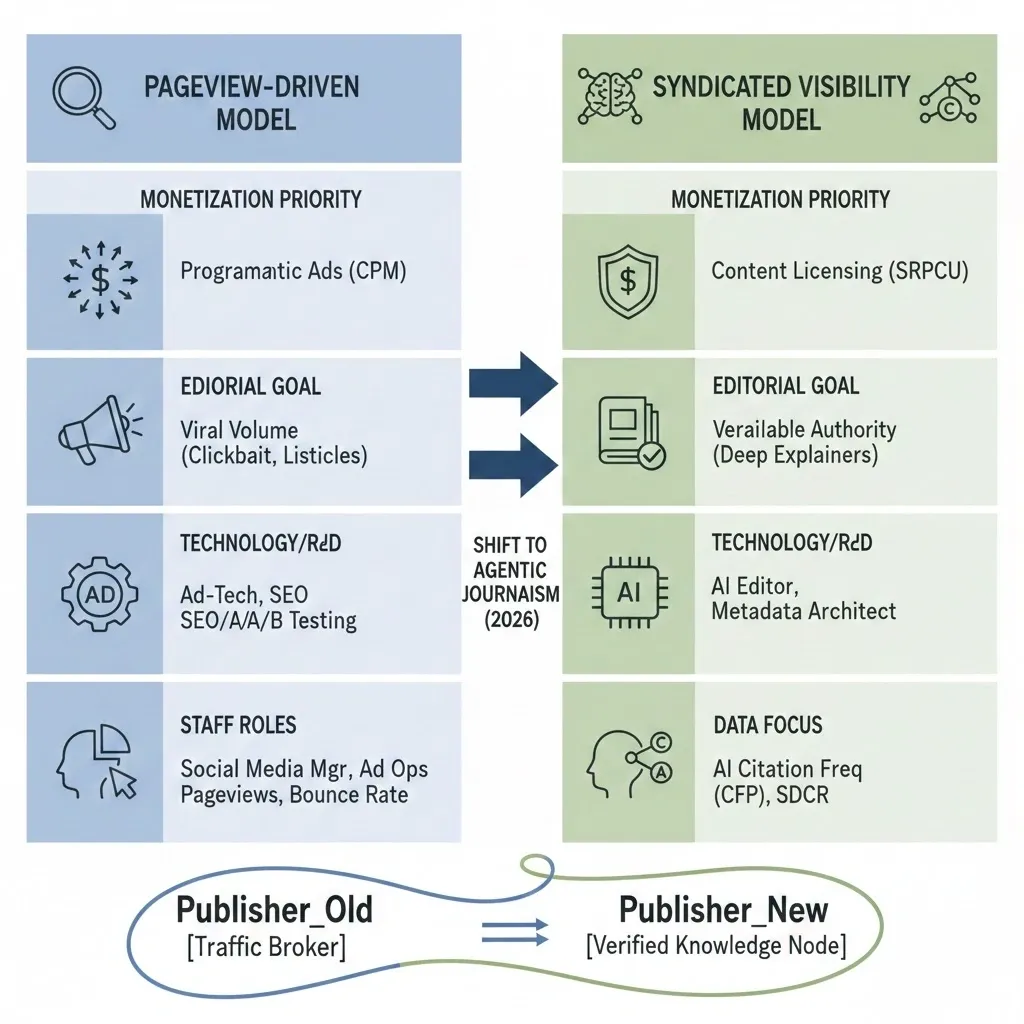
Why being quoted by machines, not clicked by humans, will decide the future of news
Introduction: When the Click Stopped Being the Unit of Truth
For nearly three decades, the economics of digital journalism rested on a deceptively simple assumption: if you could attract attention, you could monetise it. Pageviews became the proxy for relevance, clicks the proxy for value, and referral traffic the proxy for power. News organisations learned to live and die by dashboards that counted sessions, bounce rates, and organic search volume. The homepage was king. The article URL was the atomic unit of distribution.
That world is now ending—not with a dramatic collapse, but with a quiet erosion.
The defining shift of late 2025 is not that artificial intelligence can now summarise the news. That was inevitable. Nor is it that search engines are changing how results are presented. They always do. The real rupture is subtler and more consequential:
Journalism is being consumed increasingly without being visited.
Readers are no longer required to enter a publisher’s site to encounter its reporting. They meet journalism inside AI-generated answers—compressed, reassembled, contextualised, and presented as part of a larger synthetic response. The article still exists, but the user session does not.
In this new environment, the primary question for a newsroom is no longer “How many people came to us?” but rather:
“How often, how prominently, and how accurately were we quoted by the machines that now mediate knowledge?”
This is what we mean by syndicated visibility—sometimes called quoted-by-AI visibility. It is the emerging metric of success in an ecosystem where visibility flows through intermediaries that do not hand over traffic in proportion to value extracted.
The implications are profound. Journalism is returning, in a transformed guise, to a model that predates the web: syndication. But unlike wire services of the 20th century, this syndication is algorithmic, opaque, and global by default. And unlike the old world, where syndication was a supplement to direct readership, here it is fast becoming the main channel.
This essay argues that syndicated visibility is not a buzzword or a temporary adaptation. It is the structural logic of news distribution in the AI era. Understanding it—measuring it, optimising for it, and governing it—will determine whether journalism remains a viable public institution or dissolves into an uncredited input layer for machine intelligence.
I. The End of the Click-Centric World
1. The slow death of referral traffic
Search once delivered readers to publishers in abundance. That bargain—content in exchange for visibility—was never entirely fair, but it was stable enough to build an industry around. SEO became a craft, then a science, then a pathology. Entire editorial strategies were shaped by keyword demand curves and Google’s shifting incentives.
AI summaries have broken this equilibrium.
By late 2025, multiple independent datasets—industry reports, academic studies, and browser-level behavioural analyses—converged on the same conclusion: when an AI-generated answer appears, users are significantly less likely to click through to source websites. In some categories, the decline is modest; in others, catastrophic. But the direction is unambiguous.
More importantly, zero-click consumption has become normal behaviour. Users are no longer dissatisfied when they do not visit a publisher. They believe they have already “read the news” because an answer has been rendered complete at the interface level.
This is not a failure of journalism. It is a triumph of interface design.
2. Why “better headlines” will not save you
Many newsrooms initially responded with familiar instincts: optimise headlines, tighten summaries, improve metadata, hope to win back clicks. This misunderstands the nature of the shift.
AI answers are not competing with articles in the way one headline competes with another. They are replacing the act of browsing itself. The user is no longer choosing between links; the system is choosing on their behalf what to incorporate, compress, and present.
In that environment, marginal improvements in click-through rates are irrelevant. The competition has moved upstream—from user attention to machine selection.
II. Defining Syndicated Visibility
1. What it is—and what it is not
Syndicated visibility refers to a publisher’s success inside AI-mediated responses, not outside them. It captures three core dimensions:
- Presence: Is your reporting included at all?
- Prominence: Are you cited first, clearly, and authoritatively?
- Integrity: Is your work accurately represented, contextualised, and attributed?
This is not traditional syndication. There is no explicit contract for each instance of reuse. There is no negotiated placement or guaranteed audience. And there is often no click.
But functionally, it serves the same role: your journalism circulates beyond your owned surfaces, embedded in other products, generating value you do not fully control.
2. Why “quoted-by-AI” matters more than “ranked on Google”
In the classic search era, ranking first meant visibility. In the AI era, being quotable matters more than being rankable.
AI systems prefer sources that are:
- Clear and canonical
- Internally consistent
- Frequently updated and corrected
- Structurally legible (clean data, explicit claims)
- Trusted by prior training and reinforcement signals
This subtly but decisively favours certain kinds of journalism: explanatory reporting, primary-source analysis, investigative work with clear evidentiary chains. It disfavors content optimised purely for novelty or outrage without grounding.
This is not necessarily a moral victory—but it is a structural one.
III. Why Syndicated Visibility Emerged in 2025 (Not Earlier)
1. The maturation of AI interfaces
Earlier AI systems could generate text, but they were unreliable narrators. Publishers could plausibly dismiss them as toys, plagiarism engines, or hallucination factories. That dismissal is no longer credible.
By late 2025, AI-generated answers have become:
- Ubiquitous (embedded in search, browsers, devices)
- Referential (explicitly citing sources)
- Persistent (users rely on them daily)
- Economically consequential (they affect traffic, subscriptions, and ad yield)
The shift crossed a threshold from experimentation to infrastructure.
2. The collapse of the “drive traffic, then monetise” loop
The old model assumed a linear flow: Search → Article → Engagement → Revenue
AI breaks this loop: Search → Answer → Satisfaction → Exit
The article may be present, but the loop no longer passes through the publisher’s site. Once that loop breaks at scale, traffic ceases to be a reliable proxy for impact.
Syndicated visibility fills that void. It is not a perfect replacement—but it is the only metric that corresponds to where journalism is actually being consumed.
IV. The New KPI Stack in Newsrooms
1. From clicks to citations
Forward-looking publishers are already shifting internal dashboards away from raw traffic metrics and toward indicators such as:
- AI citation rate
- First-citation share
- Frequency of inclusion in AI summaries
- Licensing revenue from AI platforms
- Brand recall measured independently of site visits
This is not an abandonment of audience measurement. It is an acknowledgment that the location of audience contact has changed.
2. Measuring what machines see, not just what humans click
Traditional analytics measured human behaviour on owned properties. Syndicated visibility requires a different mindset: measuring machine-mediated representation.
This includes questions such as:
- Are our investigations being cited when AI systems answer “what happened?”
- Are our corrections propagating?
- Are our competitors’ interpretations displacing ours?
- Are we being used as a primary source or a secondary footnote?
These are editorial questions masquerading as analytics—and that is precisely why they matter.
V. The Return of Syndication—But Without the Wires
1. A historical parallel
Before the web, news circulated through wires. Local papers paid for access to national and international reporting. Attribution norms were clear. Revenue flowed through contracts. Power was concentrated, but legible.
AI-mediated distribution resembles this model in function but not in form. Instead of wires, we have models. Instead of contracts per article, we have licensing frameworks—or, in many cases, none at all. Instead of editors selecting stories, we have probabilistic systems optimising for relevance and coherence.
The danger is obvious: journalism risks becoming an invisible substrate—valuable, necessary, but uncredited and undercompensated.
2. Why visibility without compensation is not sustainable
Brand awareness alone cannot fund investigative reporting. Residual clicks measured in fractions of a percent will not support foreign bureaus. If syndicated visibility is to become the dominant mode of distribution, it must be paired with economic recognition.
This is why licensing deals, provenance standards, and regulatory pressure are not side issues. They are the battleground on which the future of journalism will be decided.
VI. Provenance as Power: Why Standards Matter
1. The rise of content provenance
Standards like C2PA are often discussed as tools for fighting misinformation. That is true—but incomplete.
Their more important function may be economic: they make attribution machine-readable and enforceable. In an AI ecosystem, what cannot be reliably attributed cannot be reliably compensated.
Publishers who invest early in clear provenance—authorship, timestamps, corrections, source trails—are not merely signalling quality. They are making themselves legible to machines.
2. Proof-carrying journalism
We are moving toward a world where journalism must carry its proof with it—not only for readers, but for systems that ingest and recombine it.
This does not mean publishing raw documents indiscriminately. It means structuring reporting so that claims, evidence, and uncertainty are explicit. AI systems reward clarity. Ambiguity, unless carefully framed, is penalised.
This may reshape journalistic style itself.
VII. Editorial Consequences: What Changes in the Newsroom
1. Writing for synthesis, not virality
If your primary reader is an AI system that will summarise your work, you begin to write differently. Not simpler—but clearer. Not shorter—but more explicit.
This does not kill narrative journalism. But it elevates a different kind of authority: the ability to be reliably summarised without distortion.
2. Corrections as competitive advantage
In the click economy, corrections were reputational hygiene. In the syndicated visibility economy, they are algorithmic signals.
AI systems trained to value accuracy will preferentially cite sources that update cleanly and transparently. A newsroom that treats corrections as first-class citizens is more likely to remain quotable over time.
VIII. Power Asymmetries and the Risk of Capture
1. Who decides what is quotable?
The most uncomfortable truth about syndicated visibility is that it is not entirely under publishers’ control. AI platforms decide:
- Which sources are trusted
- How citations are ordered
- What counts as authoritative
This introduces a new layer of power—less visible than search ranking, but more consequential.
Without oversight, this power risks reproducing existing inequities: favouring large, English-language, well-resourced publishers while marginalising local, independent, or non-Western voices.
2. Why transparency is non-negotiable
If AI systems become the primary interface to journalism, then their sourcing and attribution logic must be open to scrutiny. Otherwise, syndicated visibility becomes a black box—one that quietly reshapes the public sphere without accountability.
This is not merely a media issue. It is a democratic one.
IX. The 2026 Convergence: Visibility, Compensation, Legitimacy
1. The “quoted-by-AI channel” becomes explicit
By 2026, the informal reality of syndicated visibility is likely to crystallise into formal channels:
- Clear licensing frameworks
- Revenue-sharing agreements
- Attribution requirements
- Auditable citation logs
This will not be universal or uniform. But it will be unavoidable for any platform that relies on high-quality journalism at scale.
2. A new equilibrium—or a slow hollowing out
There are two futures available.
In one, journalism adapts to the AI layer, asserts its value, and secures compensation for its embedded role in knowledge systems. Visibility becomes measurable, legitimacy enforceable, and sustainability possible.
In the other, journalism continues to be mined as free input—visible but unpaid, cited but unsupported—until only the largest institutions survive, and even they are weakened.
Syndicated visibility is the fork in the road.
Journalism’s Second Unbundling
The first unbundling separated news from newspapers. The second is separating journalism from websites.
This is not inherently a tragedy. It may even be an opportunity—if the industry is willing to abandon obsolete metrics and confront uncomfortable truths.
The question is no longer whether people read journalism. They do. Constantly. Often without realising it.
The question is whether journalism will be seen, credited, and paid for in the systems that now mediate reality.
Syndicated visibility is not the end of journalism’s struggle. It is the new terrain on which that struggle will be fought.
Those who understand it early will shape the rules. Those who cling to the click will measure their own disappearance—one declining graph at a time.
How Do You Measure Influence When No One Clicks?
For thirty years, journalism had a crude but dependable truth machine.
If people came, journalism mattered. If they didn’t, it didn’t.
The click was imperfect, easily gamed, often misleading — but it had one virtue: it was observable. Editors could argue about quality, but the traffic chart settled relevance disputes with brutal finality.
That truth machine has stopped working.
Today, journalism is consumed constantly without anyone ever arriving at a publisher’s site. A reader asks an AI system what happened. The system answers fluently. The reader leaves. The newsroom sees nothing.
No visit. No scroll. No signal.
Yet the journalism was there — cited, paraphrased, relied upon.
This is not a traffic problem. It is a measurement collapse.
When Use Stops Looking Like Attention
What has broken is not interest in news. It is the assumption that use produces visitation.
Multiple independent analyses now show the same pattern: when AI summaries appear, downstream clicking falls sharply. In some categories, clicks drop from the mid-teens into single digits. In others, they nearly vanish. Even when links are shown, only a tiny fraction of users follow them.
This matters because it breaks the old inference chain:
visibility → clicks → influence → revenue
AI answers sever the middle of that chain. Journalism still shapes understanding, but the signal never reaches the publisher.
If you keep measuring influence through traffic alone, you are now measuring absence, not impact.
1) Start by fixing the definition (or your metric will drift)
The first failure mode is always semantic. If you don’t lock the definition, you will “improve” the metric by changing what it means.
So fix it:
Syndicated visibility = how often, how prominently, and how correctly your reporting is used inside AI answers for the queries you care about.
That implies three measurement dimensions:
- Presence: are you cited/linked/quoted at all?
- Prominence: are you top-cited, early, or deeply buried?
- Effect: does it create recall, trust, subscriptions, or any click-outs?
This needs to exist for a blunt reason: AI summaries reduce downstream clicking. Pew’s browsing-data analysis found result clicks were lower when AI summaries appeared (e.g., 8% vs 15% in their sample), and click-through on cited links is tiny. (Pew Research Center)
This is the whole point: you can be used without being visited. That’s why “traffic” can no longer be your truth machine.
2) Choose your “AI surfaces” and lock them as measurement channels
You measure “syndicated visibility” the same way you’d measure share of shelf in retail: define the shelf (which AI surfaces + which queries), take repeated samples, and compute share, position, and outcomes — with strong controls for geography, device, and query demand.
Treat each surface as its own shelf. Mixing them early produces a clean number and a dirty conclusion.
Your minimum channel map:
- Google AI Overviews / AI Mode (SERP layer; often “no session” for publishers) (Pew Research Center)
- Chat assistants (ChatGPT / Gemini / Claude-style)
- Answer engines (Perplexity-style citation-first summaries)
- Browser-integrated assistants (sidebars, OS features)
Don’t aggregate them into one composite number until you can measure each separately. Different interfaces produce different citation behaviour, different link behaviour, different distortion risk.
3) Build a “query universe” (this is your sampling frame)
If you don’t define the questions, you can’t measure the answers.
You need a stable list of prompts/queries, updated monthly, stratified by:
- Topic vertical (politics, business, tech, health, sports, local, etc.)
- Intent: breaking (“what happened”), explainer (“why”), service (“how to”), evergreen (“who is”), investigative (“what evidence”)
- Geo (US/India/UK etc.), language, device (mobile/desktop)
Two sets are essential:
- Head set: high-demand, high-stakes queries where visibility shapes public belief.
- Long-tail set: the messy, everyday questions where AI answers quietly replace browsing altogether.
If you don’t have reliable query demand, run the system anyway — but be honest about what you’re measuring: share of sampled answers, not audience-weighted share.
4) Collect answers in a repeatable way
This is where newsrooms stumble because they want platforms to report visibility back to them. Most won’t. So you capture it.
You want repeatable crawling + archival:
- Same queries
- Same locales
- Same devices/user agents where possible
- Same cadence (daily for breaking sets, weekly for evergreen sets)
Store raw outputs: answer text, timestamp, citations/links shown, and (if possible) position/order. Archive like a newsroom archives public records: because later you will need to prove what the system said.
For Google AI Overviews, you typically can’t rely on Search Console alone because the AIO layer is not cleanly reported; many publishers use third-party SERP capture workflows and panels.
This is not elegant. It is empirical.
5) Compute core KPIs (the minimum viable set)
You don’t need twenty numbers. You need a small set that maps cleanly to presence, prominence, correctness, and outcomes.
A) Presence metrics (coverage)
Presence answers a binary question: do you appear at all?
- Citation Rate (CR) CR = (number of queries where your domain is cited at least once) ÷ (total queries sampled)
- Quote Rate (QR) QR = (queries where your text is directly quoted or closely paraphrased with attribution) ÷ (total queries)
B) Prominence metrics (share of attention inside the answer)
Prominence asks where you appear when you do. Being first matters. Being buried does not.
- Top-Cited Share (TCS) TCS = (queries where you are the first citation / first linked source) ÷ (queries with any citations)
- Citation Share of Voice (SOV) SOV = (total citations to you) ÷ (total citations to all publishers in sample)
- Position-weighted Citation Score (PWCS) PWCS = Σ w(position) each time you’re cited Example weights: w(1)=1.0, w(2)=0.6, w(3)=0.4, w(4+)=0.2 Pick weights and keep them fixed, or you’ll “improve” your score by changing your ruler.
Order functions like a front page. The first cited source anchors the frame. Later sources inherit it.
C) Correctness / integrity metrics (the trust layer)
There is a more dangerous layer few publishers are prepared for: incorrect visibility.
AI systems sometimes cite journalism inaccurately. They merge reporting. They flatten nuance. They attribute claims to outlets that never made them.
So syndicated visibility must include correctness — not as philosophy, but as audit.
- Attribution Accuracy (AA) AA = (citations where the claim is actually supported by the cited article) ÷ (citations to you)
- Misattribution Rate (MR) MR = (cases where your brand is credited for something you did not report) ÷ (all mentions of your brand in answers)
This requires a human audit sample — small, consistent, relentless (e.g., 100 citations/week). You don’t need perfection. You need detection.
D) Outcome metrics (what you get back)
Effect asks whether this visibility does anything observable downstream — delayed subscriptions, brand recall, even minimal click-outs — or whether your journalism is being fully absorbed without return.
Minimum outcomes:
- AI Referral Sessions
- Engaged AI Referrals
- Assisted Conversions
Pew’s work suggests many users don’t click when an AI summary is present, so outcomes must include non-click impact (brand lift). (Pew Research Center)
6) Add the missing piece: “visibility per demand”
Raw citation counts lie when your sample is skewed. Ten citations in low-demand queries can look like success. One citation in a high-demand query can matter more.
So weight by demand/impressions where possible:
Demand-weighted SOV (DW-SOV) DW-SOV = Σ [ Demand(q) × VisibilityScore(q) ] ÷ Σ Demand(q)
Where VisibilityScore(q) can be deliberately simple:
- 1.0 if top-cited
- 0.6 if cited but not top
- 0 if not cited
This turns a “lab metric” into something closer to market reality.
7) Create a single index only after you can trust the components
Eventually, everyone wants a single score. A line that goes up or down. A number to show the board.
That is fine — but only at the end.
Composite indices freeze assumptions into structure. Change them too often and trends evaporate. Build them too early and you hide failure modes.
If you do build one, it should be explicit and stable:
Syndicated Visibility Index (SVI) SVI = 0.35·CR + 0.25·PWCS + 0.20·AA + 0.20·OutcomeScore
OutcomeScore can be a normalized blend of AI referrals + assisted conversions + brand-lift survey results.
Keep it stable for a year. If you change it, version it.
8) Instrument your content to make measurement cleaner
Two reasons: (i) AI systems are more likely to cite clear, canonical sources. (ii) you need to disambiguate versions and corrections so attribution doesn’t decay.
Practical steps:
- Strong canonicals + stable URLs
- Clear update logs (“updated at …”)
- Machine-readable metadata
- Content provenance signing where applicable (C2PA / Content Credentials; IPTC implementation guidance) (C2PA)
This won’t guarantee citations. But it improves your ability to audit and contest misuse, and aligns with where provenance standards are moving. (C2PA)
9) Validate with “lift tests” (otherwise you’re just observing)
If you only measure, you’re watching weather. If you run lift tests, you’re doing science.
Run controlled changes for a subset of topics/pages:
- Add structured “Key facts / Evidence / What we don’t know” blocks
- Improve canonical explainers that AI can reliably cite
- Tighten headline disambiguation (names, places, dates)
Then compare pre/post shifts in CR, PWCS, AA, outcomes — against a control group.
This is what turns syndicated visibility from a vanity metric into an optimisation loop.
What to watch in late 2025–2026?
The measurement fight is sliding toward a rights fight.
Regulatory pressure and publisher pushback are increasing around AI layers substituting for the open web, especially around Google’s AI Overviews. (Reuters)
That matters because syndicated visibility will increasingly tie into rights, attribution, and compensation, not just analytics.
In the AI era, measurement is not neutral. It is the foundation of bargaining power.
Search for:
Agentic Journalism
Synidcated Visibility
Journalism in AI Era